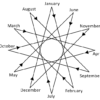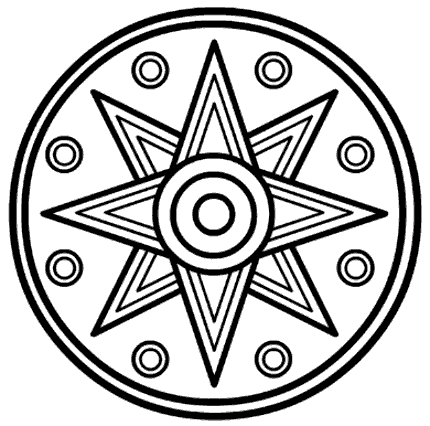
From the ancient Star of Ishtar in Mesopotamia and the Star of David in Judaism to the Rub el Hizb in Islam and the Lakshmi Star in Hinduism, star symbols have appeared across diverse cultures, civilizations, and spiritual traditions.
For thousands of years, they have been used to represent profound ideas about life, creation, the cosmos, and the hidden forces that shape existence.
In this article, we’ll explore 10 of the most ancient and powerful star symbols and uncover their hidden meanings and symbolism. Let’s begin.
10 Ancient Star Symbols & Their Deeper Symbolism
1. 3-Pointed Star (Trigram)
The three-pointed star, or Tristar, is derived from the Triquetra. The Triquetra is formed using three overlapping circles arranged so that each circle passes through the center of the other two.

As shown in the image below, the three-pointed star can be formed by connecting the outer vertices of the Triquetra with straight lines.
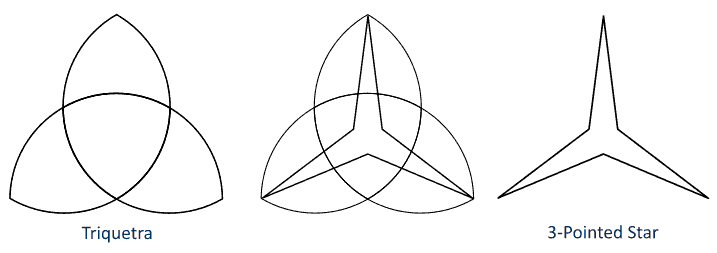
Similar to the Triquetra, the Three-Pointed Star symbolizes the power of three and the many universal patterns that occur in sets of three throughout existence. Examples include:
- Holy Trinity — Father, Son, and Holy Spirit.
- Mind, Body, and Spirit.
- Past, Present, and Future.
- Birth, Life, and Death.
- Creation, Preservation, and Destruction.
- Land, Sea, and Sky.
- Beginning, Middle, and End
- Youth, Middle Age, Old Age
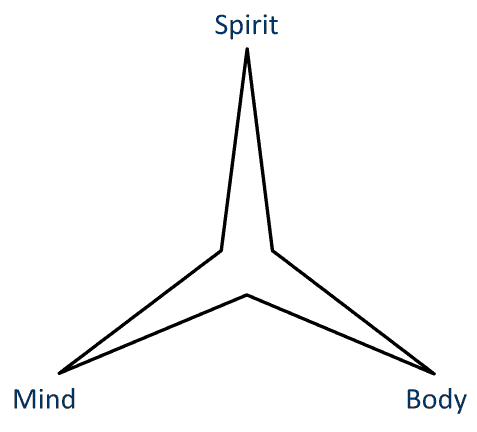
Hence, the Three-Pointed Star is a powerful symbol of the universal patterns that shape our world.
2. Four-Pointed Star (Tetragram)
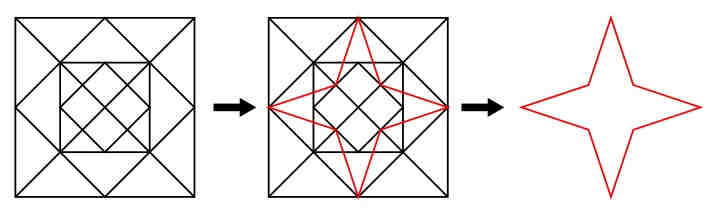
There are several ways to draw a four-pointed star. One of the simplest methods is to start with a square, as shown in the image below.
It represents important patterns that occur in sets of four, referred to as the quadruplicities of nature. A example is the four seasons: Spring, Summer, Autumn, and Winter.
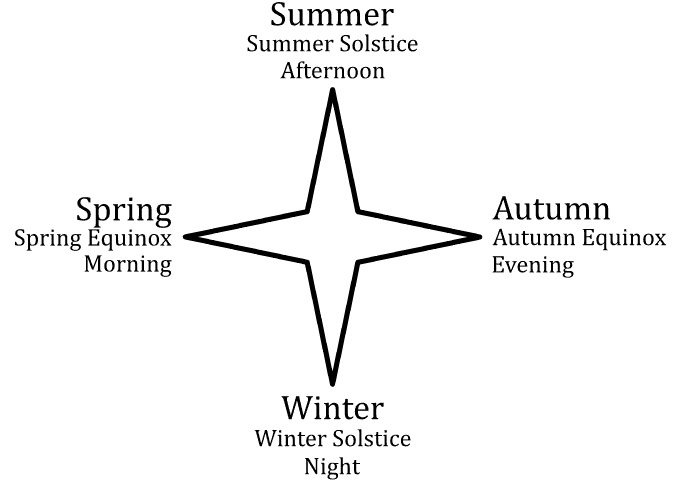
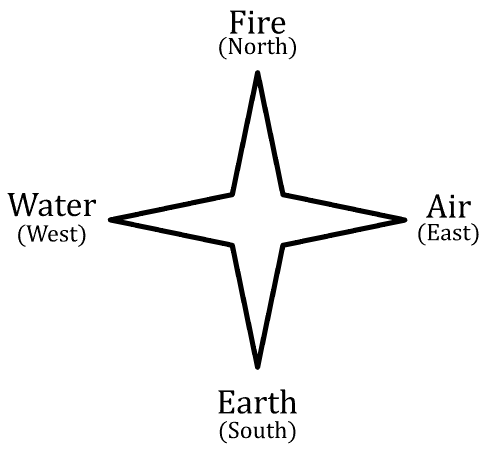
Some other important sets of four represented by the Four-Pointed Star include:
- Four Seasons: Spring, summer, autumn (fall), and winter.
- Four Cardinal Directions: North, south, east, and west.
- Four Elements: Earth, water, air, and fire.
- Four Phases of the Moon: New moon, first quarter, full moon, and last quarter.
- Four Major Solar Events in a Year: 2 Equinoxes and 2 Solstices.
- Four phases in a day: Morning, afternoon, evening, and night.
The star also represents the concept of creation, as it contains a cross within, as shown in the image below.
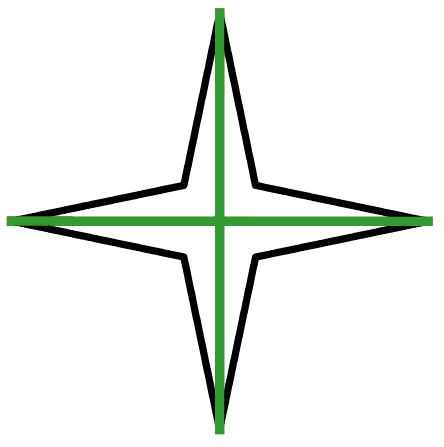
The vertical arm of the cross symbolizes masculine energy, while the horizontal arm represents feminine energy. Their point of intersection, which is at the center of the star, symbolizes the source of all creation.
Overall, the 4-pointed star represents interconnection, physical reality, balance, harmony, the dual nature of the universe, and the eternal cycle of life.
3. Five-Pointed Star (Pentagram)
The Five-Pointed Star, or Pentagram, is an ancient symbol that has appeared in many cultures and civilizations, including ancient Mesopotamia, Egypt, Greece, and medieval Europe.
The pentagram represents the five elements and the interconnectedness between them: Fire, Air, Water, Earth, and Ether (or Spirit).
Ether is considered the subtle energy that permeates and unites the other four elements. In the pentagram, it is commonly represented by the topmost point, as shown in the image below.
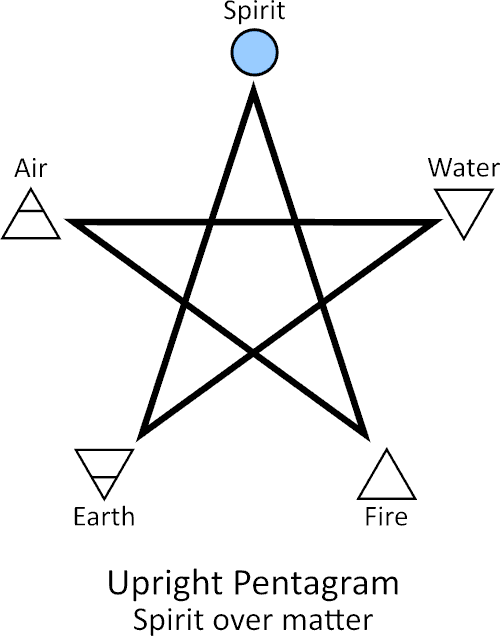
The meaning of the pentagram changes based on its orientation.
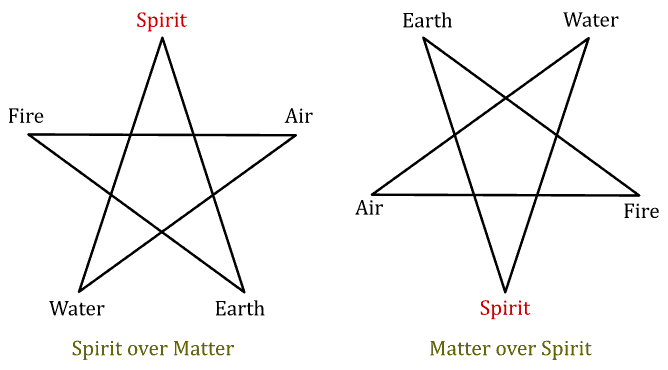
When the pentagram is facing upwards, it signifies the victory of spirit (spiritual realm) over matter (material realm) and when it faces downward it signifies the victory of matter over spirit.
Each new pentagram is inverted relative to the one surrounding it, creating an alternating sequence of upward- and downward-pointing pentagrams that extends endlessly.
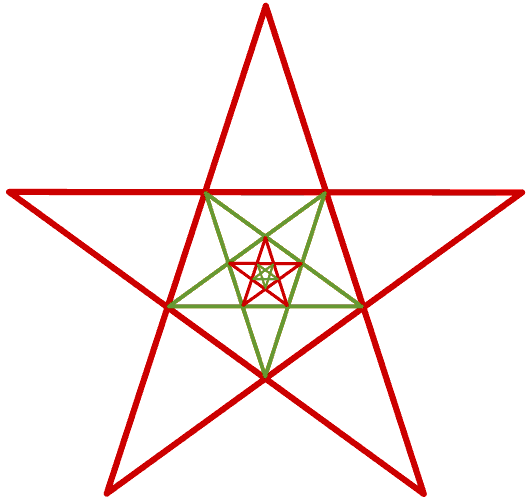
This self-repeating pattern and the presence of opposites symbolizes infinity, interconnectedness, duality, and the fractal nature of reality.
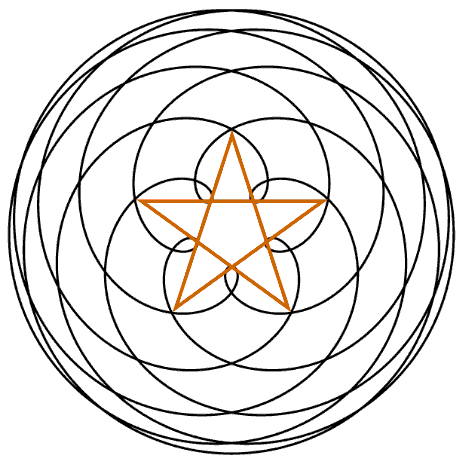
Additionally, the pentagram is also associated with feminine energy because of its connection to the planet Venus. Over an eight-year cycle, the positions of Venus relative to Earth trace a pattern that closely resembles a five-pointed star.
4. Six-Pointed Star (Hexagram)

The Six-Pointed Star (Hexagram), is an ancient symbol that appears in many cultures and spiritual traditions. In Hinduism, it is known as the Shatkona or Shiva-Shakti Star; in Judaism, it is called the Star of David; and in Islamic tradition, it is known as the Seal of Solomon.
This star is formed by two overlapping equilateral triangles, one pointing upward and the other downward, that share the same center.
In sacred geometry, the upward-pointing triangle is associated with the Divine Masculine, while the downward-pointing triangle represents the Divine Feminine. Their union symbolizes balance and creation, and the shared center is seen as the source from which all creation emerges.
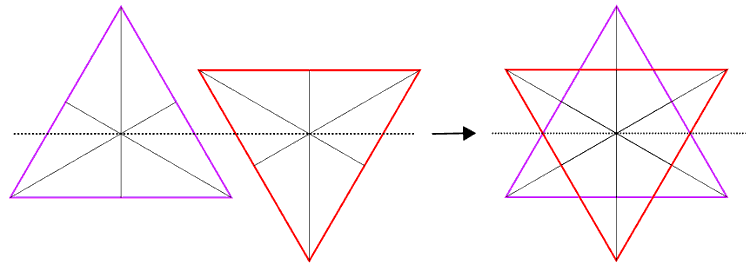
Consequently, the hexagram symbolizes balance, harmony, interdependence, duality, oneness, and creation.
The star also has another form known as the Unicursal Hexagram. Unlike the regular hexagram, which is formed by two separate triangles, the unicursal hexagram can be drawn in a single continuous line without lifting the hand (as shown in the image below).

This continuous form symbolizes the interconnectedness of the Divine Masculine and Divine Feminine and the eternal, cyclical nature of life.
5. Seven-Pointed Star (Heptagram)
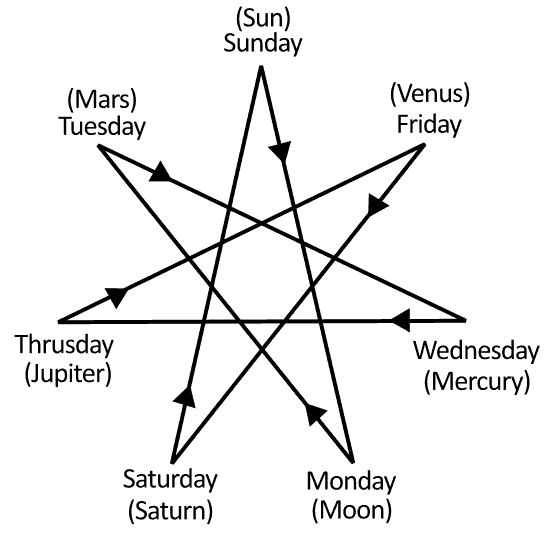
The Seven-Pointed Star, or Heptagram, is a symbol with a rich history and a wide range of meanings.
In ancient Babylon, it was associated with the seven celestial bodies known at the time: the Sun, Moon, Mars, Mercury, Jupiter, Venus, and Saturn.
These heavenly bodies were considered sacred, and each was assigned a day of worship, giving rise to the seven-day week that is still used today.
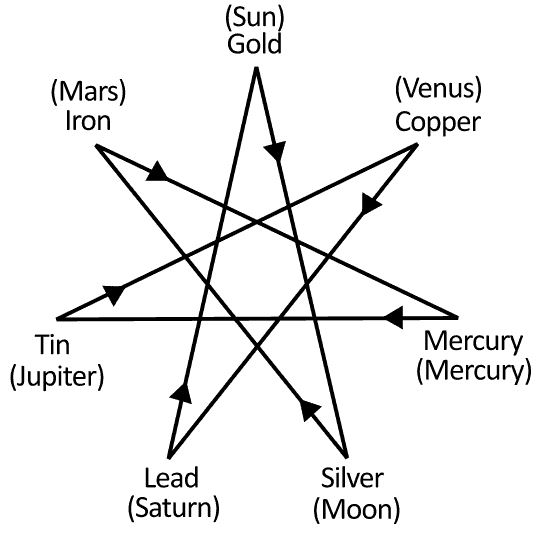
Thus, the Heptagram symbolizes both the seven days of the week and the seven planets. In addition, it was also used to symbolize the seven sacred metals tied to these planets, which are as follows:
- Gold – Sun – Sunday
- Silver – Moon – Monday
- Iron – Mars – Tuesday
- Mercury – Mercury – Wednesday
- Tin – Jupiter – Thursday
- Copper – Venus – Friday
- Lead – Saturn – Saturday
In many ancient cultures, the Seven-Pointed Star was used as a protective symbol believed to ward off negative forces.
In Hinduism, it is associated with solar energy and the seven horses that draw the chariot of the Sun God Surya. These seven horses are linked to the seven colors of white light. Because of this connection, the Seven-Pointed Star symbolizes light, illumination, vitality, wisdom, and spiritual awakening.
According to the Book of Genesis, God created the world in six days and rested on the seventh. This concept of a seven-day creation is also represented by the seven-pointed star. Given that the universe was completed in 7 days, the 7-pointed star is seen as a symbol of completeness, perfection and divine order.
6. Eight-Pointed Star (Octagram)
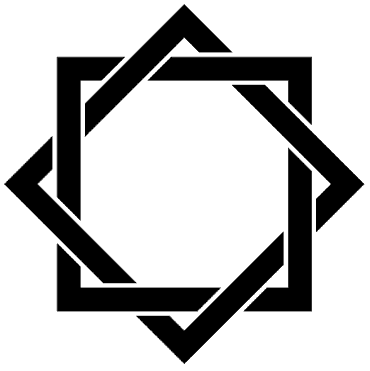
The Eight-Pointed Star is one of the most widely recognized sacred geometry symbols, second only to the Six-Pointed Star. It appears in many ancient cultures and spiritual traditions, where it has been associated with a variety of meanings and symbolic interpretations.
The Eight-Pointed Star can be drawn in two main ways, as shown below:
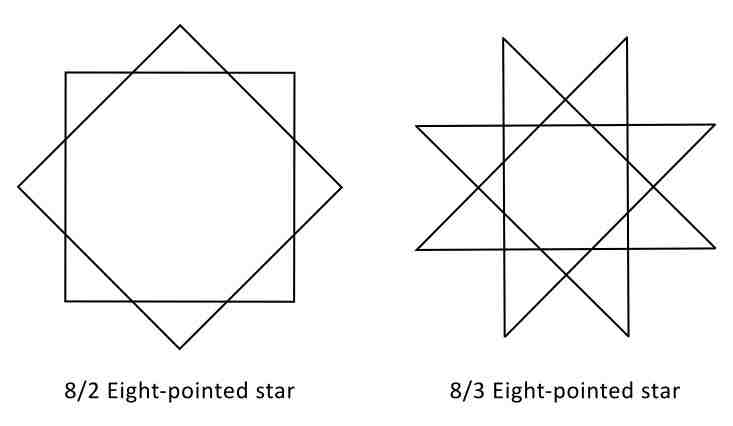
- 8/2 8-pointed star: This star is formed by two overlapping squares of equal size that share the same center. It can be created by connecting every second vertex of an octagon (8-sided polygon).
- 8/3 8-pointed star:This star is formed by connecting every third vertex of an octagon. Unlike the 8/2 star, it can be drawn in a single continuous line and is therefore known as a unicursal eight-pointed star.
Out of these the 8/2 star that consists of 2 overlapping squares is of special significance as it represents the interconnection between the Divine Masculine and the Divine Feminine and hence is a powerful symbol of creation similar to the six-pointed star.
In Hinduism the 8/2 star is known as the Lakshmi star and represents the 8 different powers of Goddess Lakshmi who is the Goddess of Wealth, Prosperity, and Abundance.
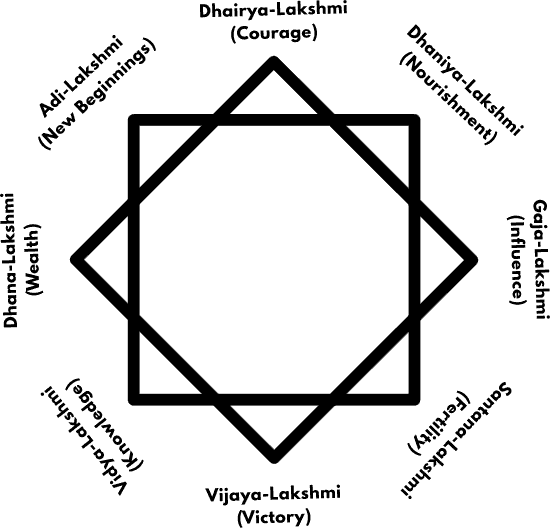
These 8 forms are as follows:
- Adi Lakshmi (Goddess of New Beginnings)
- Dhana Lakshmi (Goddess of Wealth)
- Dhanya Lakshmi (Goddess of Agricultural Prosperity)
- Gaja Lakshmi (Goddess of Power and Royalty)
- Santana Lakshmi (Goddess of Family and Progeny)
- Veera Lakshmi (Goddess of Courage and Bravery)
- Vijaya Lakshmi (Goddess of Victory and Success)
- Aishwarya Lakshmi (Goddess of Spiritual and Divine Wealth)
The Rub-el-Hizb which is an ancient Arabic symbol also has the same design consisting of two overlapping squares, The symbol is known as khatim or khatim-sulayman, which means ‘Seal of Prophet Solomon’ and is said to have magical powers.
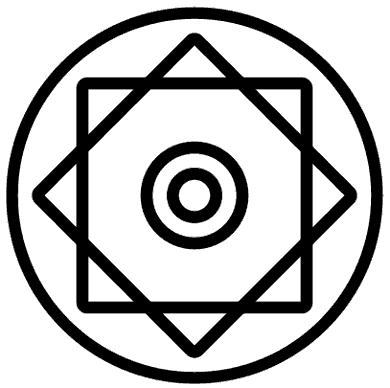
In Estonia the 8/3 eight-pointed star is considered sacred. Called the Kaheksakand (kaheksa=8 and kand=star) this star is used as a protective talisman for protection against evil eye and negative energies.
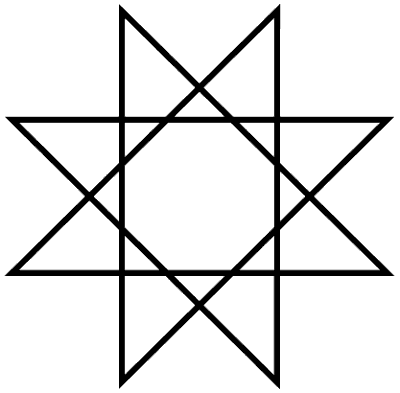
Dating back to around 2000 BCE, the Eight-Pointed Star was a symbol of Ishtar, the Mesopotamian goddess of love and war.
The star was closely associated with the planet Venus, which the Mesopotamians regarded as sacred because it appeared as the first light at dawn and the last light at dusk. Because of this connection, the Eight-Pointed Star came to symbolize illumination, hope, wisdom, beauty, and divine power.
In the Wiccan (and many pagan) tradition, the 8-pointed star represents the 8 major solar and seasonal events that occur throughout the course of a year. This includes the 2 equinoxes (Spring Equinox & Autumn Equinox), and 2 solstices (Summer Solstice & Winter Solstice), and the four seasons – Spring, Summer, Autumn, and Winter.
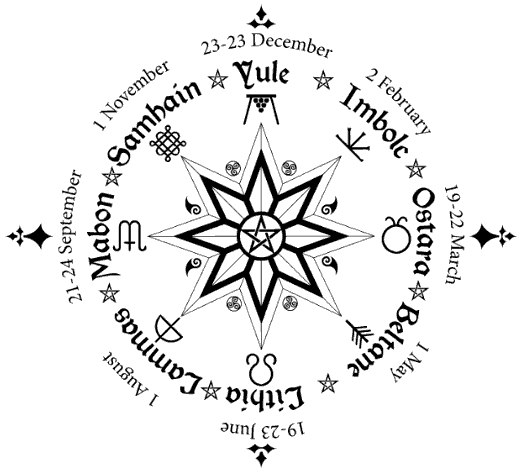
All these events are celebrated by Wiccans. The names of the festivals associated with these events are as follows:
- Yule – Winter Solstice (20 – 23 December)
- Imbolc – Beginning of Spring (1st February)
- Ostara – Spring Equinox (19 – 22 March)
- Beltane – Beginning of Summer (1st May)
- Litha – Summer Solstice (19 – 23 June)
- Lughnasadh – Beginning of Autumn (1st August)
- Mabon – Autumn Equinox (21 – 24 September)
- Samhain – Beginning of Winter (1st November)
In Buddhism, the Eight-Pointed Star is associated with the Dharma Chakra (Wheel of Dharma) and represents the Noble Eightfold Path, the path to enlightenment taught by the Buddha. The eight principles of this path are Right View, Right Intention, Right Speech, Right Action, Right Livelihood, Right Effort, Right Mindfulness, and Right Concentration.
As a result, the Eight-Pointed Star symbolizes wisdom, spiritual growth, and the journey toward enlightenment.
In Christianity, the Eight-Pointed Star is associated with the Star of Bethlehem, which, according to tradition, guided the Wise Men to the birthplace of Jesus Christ. Because of this connection, the star symbolizes hope, divine guidance, faith, and the light that leads one toward spiritual truth.
In Chinese philosophy, the 8-pointed star is used to represent the Bagua symbol that consists of 8 trigrams. The 8 trigrams are formed by different combinations of Yin and Yang and represent the 8 important natural phenomena (or elements) on earth.
- Heaven (Qian, representing the element of metal)
- Lake (Dui, representing the element of marsh or swamp)
- Fire (Li, representing the element of fire)
- Thunder (Zhen, representing the element of wood)
- Wind (Xun, representing the element of wood or tree)
- Water (Kan, representing the element of water)
- Mountain (Gen, representing the element of earth)
- Earth (Kun, representing the element of earth)
Understanding the eight trigrams of Bagua is believed to give an individual the capacity to grasp the past, present, and future.
7. Nine-Pointed Star (Nonagram)
The 9-Pointed star also known as the Nonagram and the Enneagram is a powerful ancient symbol with varied meanings. The star can be drawn in two different ways as follows:
- 9/2 9-pointed star: the 9/2 star is a unicursal star that can be drawn in a single stroke without lifting the pen. This is drawn by connecting every second vertex in a nonagon (9-sided polygon)
- 9/3 9-pointed star: The 9/3 star consists of three overlapping equilateral triangles. It is drawn by connecting every 3rd vertex in a nonagon (9-sided polygon).
Out of these stars, the 9/3 star is of special significance as it is used to represent the 3 important triplicities that work together to sustain existence. These are as follows:
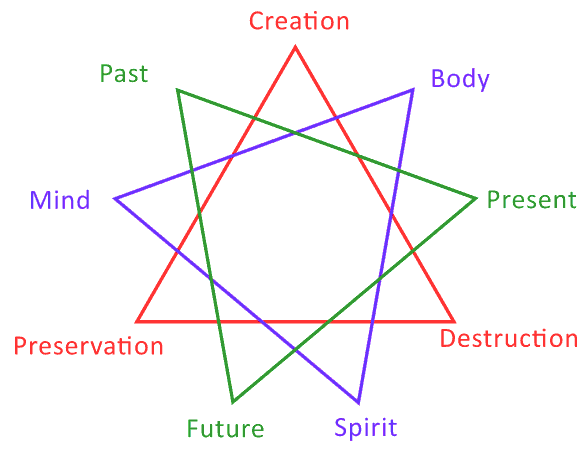
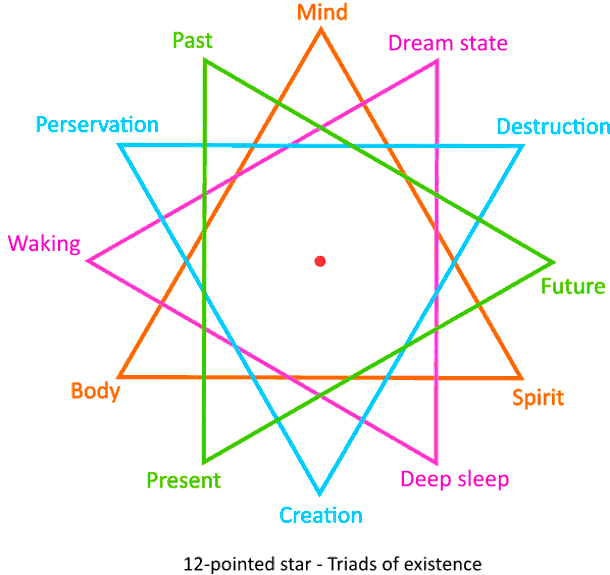
- The 1st triangle represents the primal forces of – Creation, Preservation, and Destruction (Re-creation).
- The 2nd triangle represents – Mind, Body, and Spirit which is the basis of life on earth.
- The 3rd triangle represents – Past, Present, and Future, or all of time.
The combination of these triplicities is the basis of all existence. Thus the 9/3 9-pointed star is a powerful symbol of life and creation. It also represents the eternal and ever-renewing nature of the universe.
In many spiritual traditions, the 9-pointed star is also associated with completeness, perfection, and enlightenment. This is because 9 is the highest single digit number and hence represents the completion of a cycle.
In Hinduism, the 9-pointed star holds a special significance as it represents the 9 Celestial Bodies, known as the Navagrahas (Nav meaning nine and Grahas meaning Planets). These celestial bodies include the 7 wandering planets – Sun, Moon, Mars, Mercury, Jupiter, Venus, Saturn, and the two invisible planets – Rahu, and Ketu.
Additionally, the star symbolizes the Navaratnas, which are the 9 sacred gemstones associated with these celestial bodies. These gemstones are Ruby (Sun), Diamond (Venus), Pearl (Moon), Coral (Mars), Hessonite (Rahu), Blue Sapphire (Saturn), Cat’s eye (Ketu), Yellow Sapphire (Jupiter), and Emerald (Mercury).
The star also represents the 9 forms of Goddess Durga, with each form representing a specific aspect of divine feminine energy.
8. Ten-Pointed Star (Decagram)
Also a powerful ancient symbol, the 10-pointed star (known as the Decagram) is closely associated with the Pentagram (5-pointed star). This star can be drawn in three different ways as follows:
- 10/2 10-pointed star: Drawn by connecting every 2nd vertex in a decagon (10-sided polygon) the 10/2 star consists of 2 overlapping pentagons.
- 10/3 10-pointed star: the 10/3 star is a unicursal star that is drawn by connecting every 3rd vertex in a decagon. This star can be drawn in a single stroke without lifting the pen.
- 10/4 10-pointed star: The 10/4 star is drawn by connecting every 4th vertex in a decagon. It consists of two overlapping pentagrams having the same center.
Out of these, the 10/4 star is of special significance as it consists of two overlapping pentagons one facing upward and the other facing downward.
As we already saw, since ancient times, the pentagram has been used to represent the 5 elements. Also, the meaning of the pentagram changes based on its orientation.
The top corner or vertex of the pentagram signifies spirit or spirit energy. So when the pentagram faces upward, it represents the concept of Spirit (Spiritual world) over Matter (Material world). When it faces downward, the pentagram represents the concept of Matter over Spirit. This is as shown in the image below:

Thus the 10/4 star represents the perfect balance and harmony that exists between the spiritual and material realms.
This delicate balance is crucial for the sustenance of the universe and hence the 10-Pointed star can also be seen as a powerful symbol of creation just like the 6-Pointed Star.
9. Eleven-Pointed Star (Hendecagram)
In various spiritual traditions, the 11-pointed star is seen as a gateway or portal to higher levels of consciousness and spiritual realms. This is because, in numerology, 11 is considered a master number. It’s associated with spiritual insight, intuition, and enlightenment.
The star is also associated with duality because the number 11 is made up of two ones. This reflects the existence of complementary opposites, such as light and dark, masculine and feminine, or material and spiritual.
At the same time, the two ones standing side by side suggest unity and harmony, symbolizing the coming together of opposites to form a greater whole.
10. Twelve-Pointed Star (Dodecagram)
The 12-Pointed star known as the Dodecagram is another powerful symbol that has been used since ancient times to represent various aspects of life and the universe. The star can be drawn in 4 different ways each with its own unique significance. These are as follows:
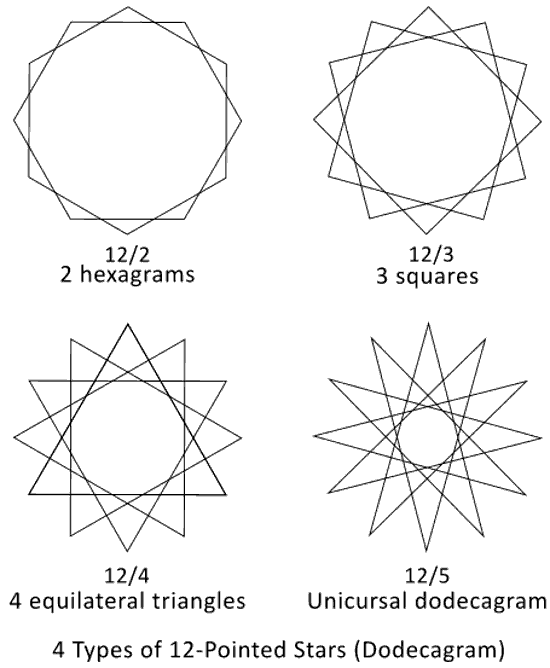
- 12/2 12-Pointed Star: The 12/2 star consists of 2 overlapping hexagons. It can be drawn by connecting every 2nd vertex in a dodecagon (12-sided polygon).
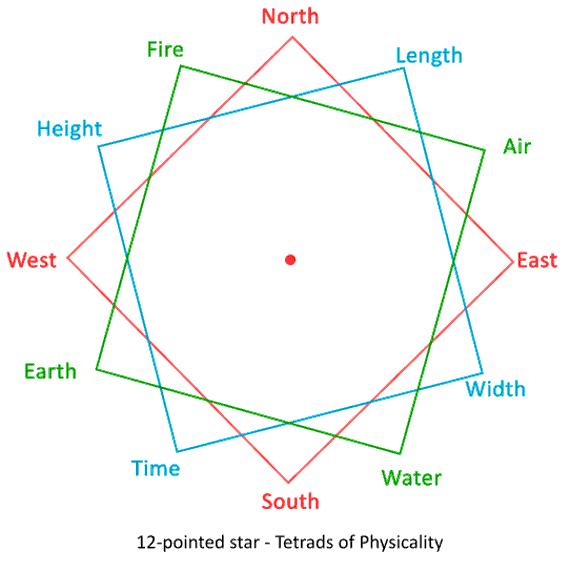
- 12/3 12-pointed star: The 12/3 star consists of 3 overlapping squares. It can be drawn by connecting every 3rd vertex in a dodecagon (12-sided polygon).
- 12/4 12-pointed star: The 12/4 star consists of 4 overlapping triangles. It can be drawn by connecting every 4th vertex in a dodecagon.
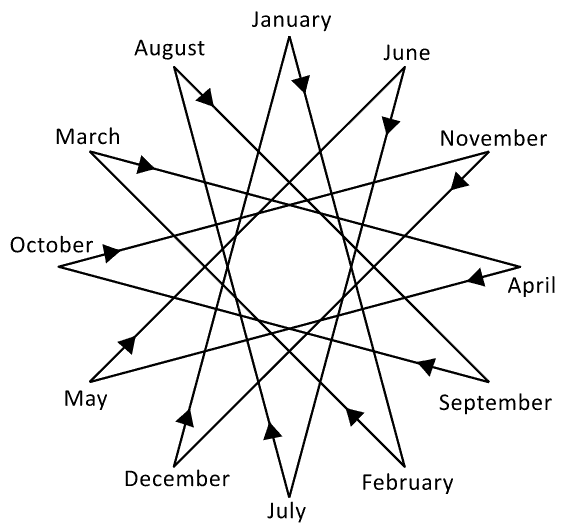
- 12/5 12-pointed star: The 12/5 star is a unicursal star that can be drawn in a single stroke without lifting the pen. It can be drawn by connecting every 5th vertex in a dodecagon.
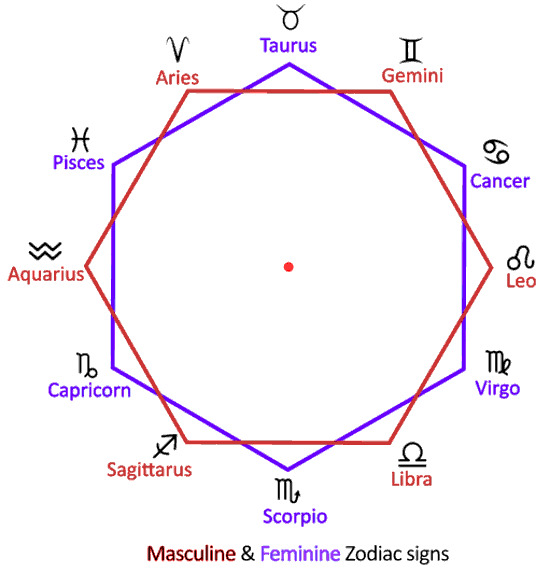
The 12/2 star, consisting of two overlapping hexagons, primarily symbolizes the 12 Zodiac signs, categorized into feminine and masculine signs as shown in the image below:
The 12/3 12-pointed star that has 3 overlapping squares represents the 3 important tetrads of physical world as depicted in the image below:
The 12/4 12-pointed star that consists of 4 overlapping triangles represents the 4 important triplicities of existence and the deep interconnection that exists between them.
The 12/5 star, which can be drawn without lifting the pen (unicursally), represents the 12 months in a year and the 12-hour clock. This star represents the concept of time and the eternal cycle of life.
In Christianity, the 12-pointed star has been used to represent the 12 disciples of Jesus Christ. In Judaism, it symbolizes the 12 tribes of Israel.
Conclusion
These are 12 of the most powerful star symbols, each carrying deep meanings that have inspired cultures and spiritual traditions for thousands of years. Together, they represent important aspects of life, creation, consciousness, and the universe itself.
If a particular star symbol resonates with you, take some time to explore it further. You might draw it, meditate on it, visualize it, wear it as a meaningful emblem, or study its history and symbolism more deeply. The more you engage with a symbol, the more insights it may reveal.