Since ancient times, certain geometric shapes, patterns, and proportions have been regarded as sacred. They are believed to contain hidden insights into the nature of the universe and the principles that govern it.
Sacred geometry is the study of these patterns and their symbolism.
In this article, we’ll explore 23 of the most powerful sacred geometry symbols and uncover the deeper meanings and universal principles they represent.
23 Powerful Sacred Geometry Symbols & Their Symbolism
1. Dot & the Circle
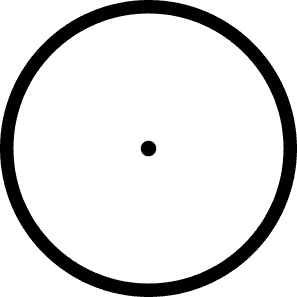
In sacred geometry, the simplest symbol is the dot, representing the One Source or pure consciousness.
The circle is the dot expanded outward. Because every point is equally distant from the center and the circle has no beginning or end, it symbolizes infinity, unity, and the cyclical nature of the universe.
When two circles overlap, they create the Vesica Piscis, one of the most important forms in sacred geometry.
2. Vesica Piscis
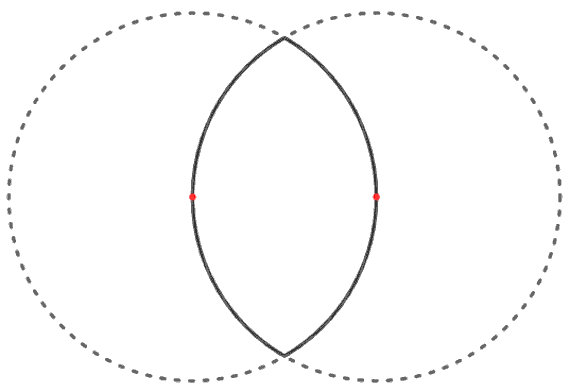
When two circles intersect, they create an almond-shaped space known as the Vesica Piscis, a Latin term meaning “fish’s bladder.” The name comes from its resemblance to the shape of a fish.
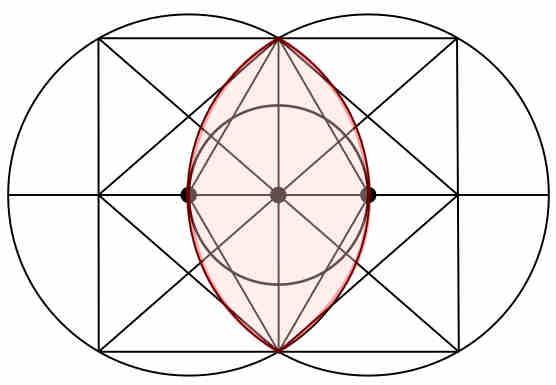
The Vesica Piscis symbolizes the Cosmic Womb – the sacred space from which creation emerges.
It represents the birth of duality from unity. One circle symbolizes spirit (the divine feminine), while the other symbolizes matter (the divine masculine). Their intersection becomes the point where creation unfolds, giving rise to new life, ideas, and realities.

As shown in the image above, when viewed horizontally, the Vesica Piscis symbolizes the Cosmic Womb. When viewed vertically, it resembles an eye and represents the Cosmic Eye or the third eye, symbolizing higher awareness, spiritual vision, and the ability to perceive beyond the physical world.
From a scientific perspective, the Vesica Piscis closely resembles the shape created when a fertilized egg first divides into two cells (as shown in the image below). These two cells continue dividing and developing, eventually forming a complete human being.
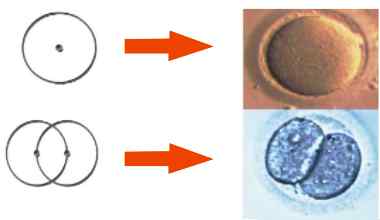
All of these factors make the Vesica Piscis a potent symbol of creation, creativity, and fertility.
The Vesica Piscis also contains within it many other important sacred geometry symbols, some of which are as follows:
- Equilateral triangle
- Diamond or Rhombus
- The cross
- Jesus Fish
- Square
- Five-Pointed Star (Pentagram)
- Six-Pointed Star (Hexagram)
The following image illustrates some sacred symbols found within the Vesica Piscis:
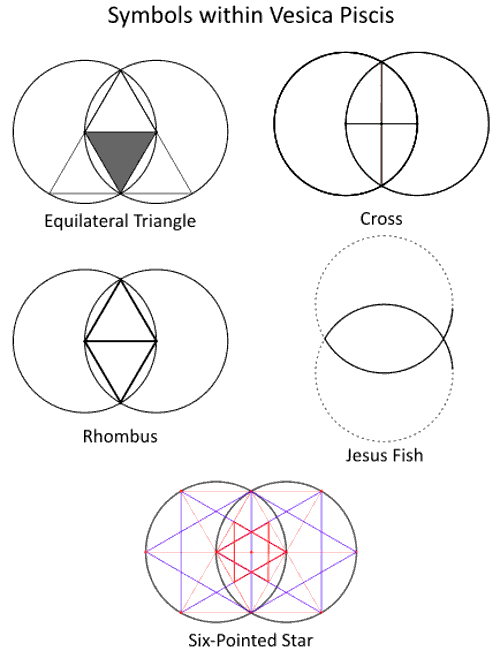
By expanding the Vesica Piscis with additional circles, more complex sacred geometric patterns begin to emerge, including the Triquetra, Seed of Life, Flower of Life, Fruit of Life, and Metatron’s Cube.
From these patterns arise the Platonic Solids, which were regarded by ancient philosophers as the fundamental building blocks of the physical universe.
3. The Triquetra
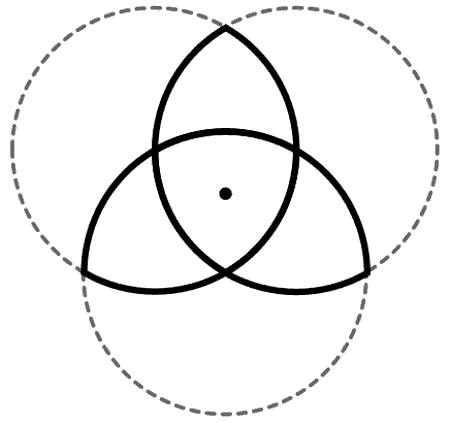
Expanding the Vesica Piscis by adding a third circle creates the Triquetra, an ancient symbol of the threefold nature of existence.

Its three points can represent many sacred triads, including:
- Holy Trinity – Father, Son, and Holy Ghost
- Mind, Body, and Spirit
- Past, Present, and Future
- Creation, Preservation, and Destruction
- Positive, Negative, and Neutral
The Triquetra also contains two interconnected triangles: a larger upward-pointing triangle representing masculine energy and a smaller downward-pointing triangle representing feminine energy (as shown in the image below).
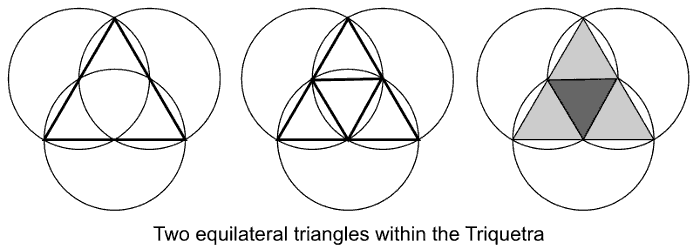
By inverting the Triquetra we get the larger triangle facing downward representing feminine energy and the smaller triangle facing upward representing masculine energy. Combining both these triquetras gives rise to the six-pointed star as shown in the image below.
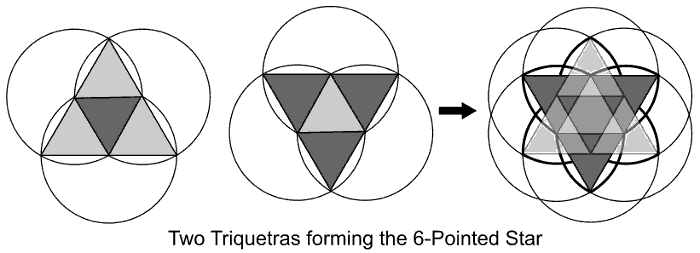
As you can see in the image above, the larger star and the smaller star within represent the concept of Yin-Yang – with the masculine present within the feminine and the feminine within the masculine. Hence this is the perfect symbol of balance and harmony.
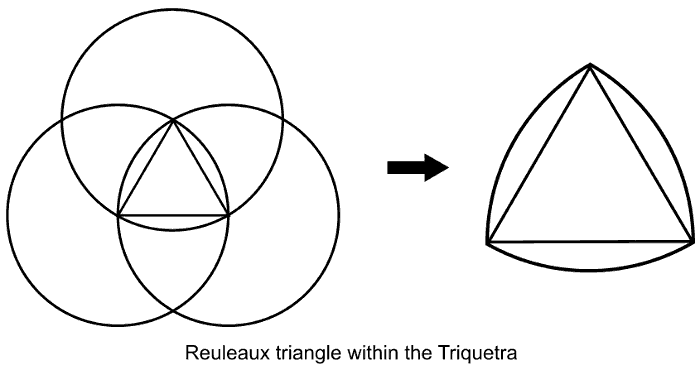
The Triquetra also contains within it the Reuleaux triangle. The Reuleaux triangle is unique because despite its curved sides it has constant width. This means, when rotated inside a square, it touches all four sides of the square at all times, just like a circle. Additionally, each point on the curve is equidistant from the opposite vertex.
Because of this, the Reuleaux triangle is seen as a symbol of stability, harmony, and balance even in the midst of change.
4. Seed of Life
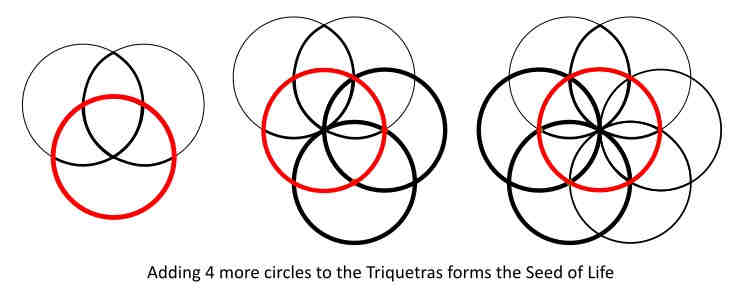
When we add 4 more circles to the triquetra, we get the Seed of Life.
The Seed of Life consists of a central circle surrounded by six circles, all connected to the center. Because every circle emerges from and connects back to the central circle, it symbolizes the idea that all creation is interconnected and arises from a single source.
Said to contain the blueprint of the universe, the Seed of Life represents creation, unity, harmony, interconnectedness, and the unfolding of life itself. It is also associated with growth, potential, and the hidden patterns that shape the universe.
The Seed of Life contains numerous other sacred geometry symbols within, such as the Six-Pointed Star, 9-Pointed Star, 12-Pointed Star, Yin Yang, Infinity symbol, and the Hexafoil (Germ of Life).
The following image shows the hexagram (six-pointed star) within the Seed of Life.
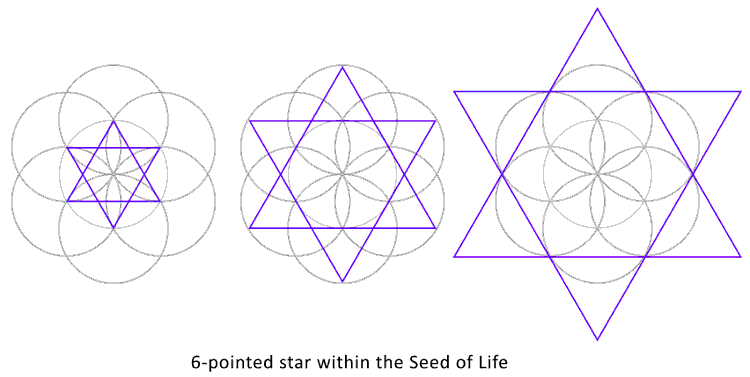
By adding more circles to the Seed of Life, you can create many more sacred geometry symbols like the Flower of Life, the Egg of Life, the Lotus of Life, the Fruit of Life, and Metatron’s Cube and the Platonic Solids.
5. Lotus of Life

When two Seed of Life patterns are overlaid and one is rotated by 30 degrees, they form a 12-circle pattern known as the Lotus of Life.
The Lotus of Life symbolizes unity, balance, harmony, interconnectedness, abundance, and eternity.
When viewed in three dimensions, it resembles a tube torus.
6. The Torus

Another remarkable sacred geometry figure derived from the Seed of Life is the Torus. This shape is formed when you overlay 8 Seed of Life patterns and rotate each by a small degree. This is as shown in the video below:
The Torus is a doughnut-shaped energy pattern found throughout nature. Many electromagnetic fields including those associated with atoms, living organisms, the human heart, and even planets display toroidal characteristics. Some theories also suggest that Earth exists within a vast torus-shaped electromagnetic field.
Because energy flows outward from the center and returns back to it in a continuous cycle, the Torus symbolizes wholeness, interconnectedness, balance, life cycles, and infinity. It represents the idea that everything is part of a continuous flow, where beginnings and endings merge into one ongoing process.
7. Egg of Life
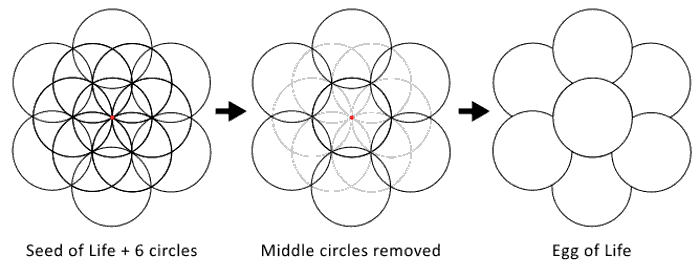
When the Seed of Life is expanded by adding six more circles and the inner circles are removed, the remaining pattern forms the Egg of Life. When viewed as three-dimensional spheres rather than flat circles, it consists of eight spheres – six arranged around the center, with one above and one below.
The Egg of Life can be thought of as the three-dimensional version of the Seed of Life.
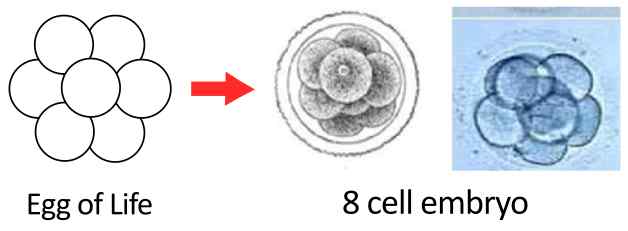
Just as the Seed of Life incorporates the Six-Pointed Star, the Egg of Life includes the Merkabah, which is the 3D version of the Six-Pointed Star. Hence it also represents balance, unity, and interconnection.
8. Flower of Life
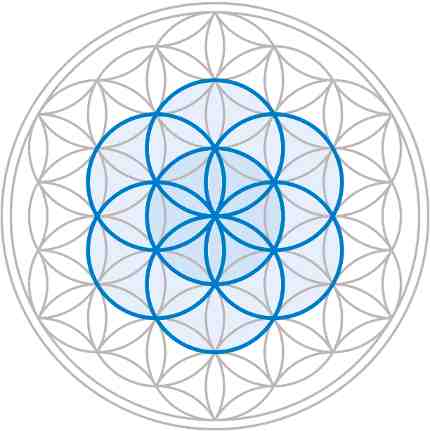
By expanding the Seed of Life with twelve additional circles, you create the Flower of Life, one of the most recognizable symbols in sacred geometry.
The Flower of Life symbolizes creation, unity, harmony, and the interconnectedness of all life. Many sacred geometry traditions regard it as a map of the fundamental patterns underlying existence.
Within its structure, many other sacred geometric forms can be found, including the Six-Pointed Star, the Tree of Life, the Fruit of Life, Metatron’s Cube, and the Platonic Solids.
9. Fruit of Life & the Metatron’s Cube
By expanding the Flower of Life by adding more circles, we arrive at the Fruit of Life pattern which is a set of 12 circles surrounding the central circle.
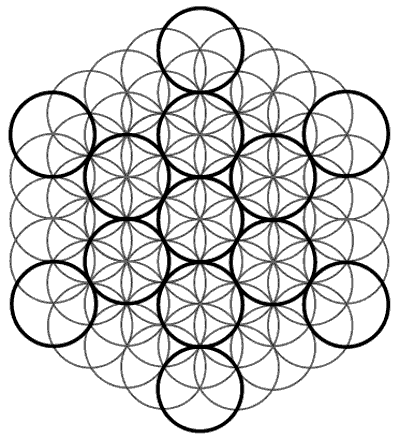
The circles in the Fruit of Life represent the Divine Feminine. When the centers of these circles are connected with straight lines (which adds up to 78 lines in total), the result is Metatron’s Cube, one of the most important symbols in sacred geometry.
The 78 straight lines represent the Divine Masculine and the circles represent the Divine Feminine. Hence the Metatron’s Cube represents the union of the Divine Masculine and Divine Feminine which is the basis of all creation.
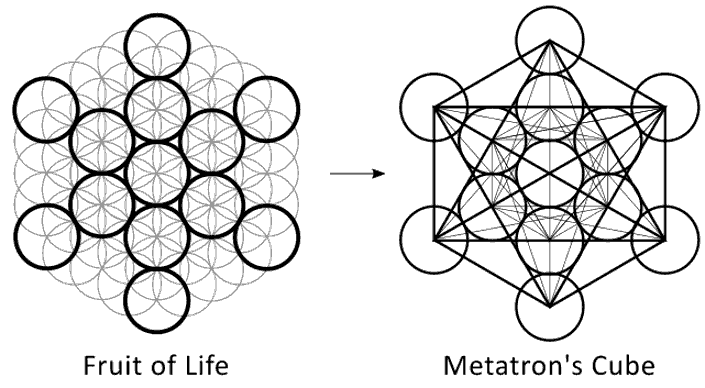
What’s unique about the Metatron’s Cube is that it houses within it all five platonic solids that ancient philosophers regarded as the fundamental building blocks of the physical universe.. (as shown in the image below)
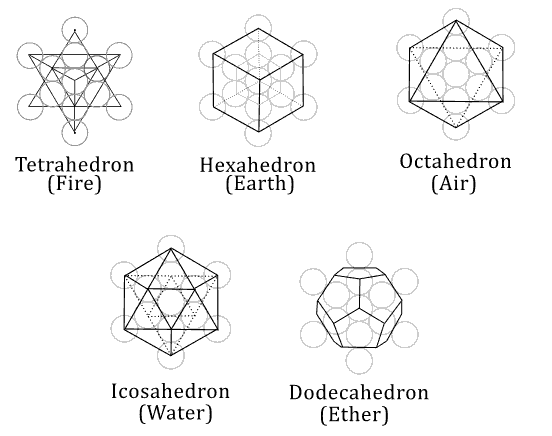
The Platonic Solids, and their various combinations, are believed to represent the geometric principles underlying the physical world.
10. Platonic Solids
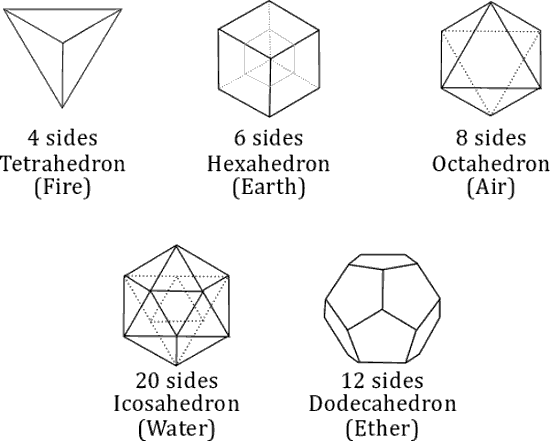
Platonic Solids are five highly symmetrical geometric shapes that were studied by Plato and later came to be associated with the fundamental elements of nature.
- Tetrahedron (4 triangular faces) – Fire
- Cube (Hexahedron) (6 square faces) – Earth
- Octahedron (8 triangular faces) – Air
- Dodecahedron (12 pentagonal faces) – Ether (Spirit)
- Icosahedron (20 triangular faces) – Water
What makes these shapes unique is that:
- All edges are the same length.
- All faces are identical.
- Every corner (vertex) is exactly the same as every other corner.
- All their vertices fit perfectly within a sphere.
Because of this perfect symmetry, Platonic Solids are seen as symbols of balance, harmony, order, and stability.
Platonic Solids appear throughout nature at both the microscopic and macroscopic levels. For example, pyrite crystals naturally form into cubes, carbon atoms in diamonds arrange themselves in tetrahedral patterns, and boron molecules can take on structures resembling an icosahedron.
Other structures, such as pollen, microorganisms, fractals, sound waves, snowflakes, and even cellular formations, also mimic the geometry of Platonic solids.
Polygons and Polygrams (Star Symbols)
A polygon is a flat shape made of straight sides that are connected end-to-end. Common examples include a triangle (3 sides), square (4 sides), pentagon (5 sides), and hexagon (6 sides).
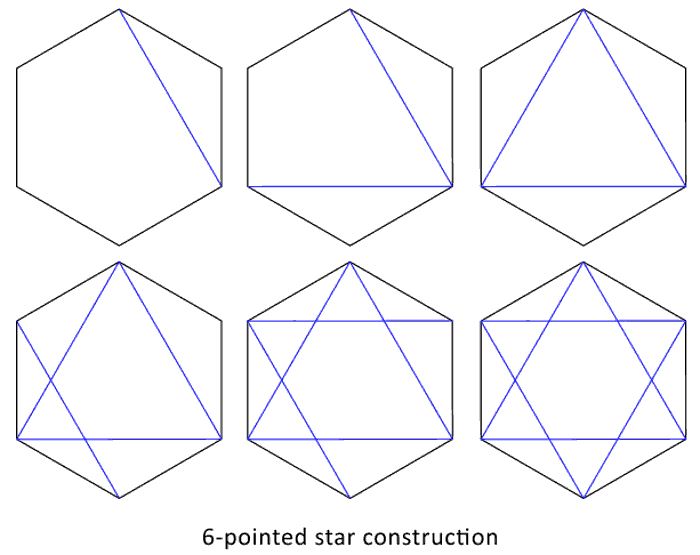
Interestingly, by connecting the non-adjacent corners of a polygon, you can create star-shaped figures known as polygrams. For example, connecting every other corner of a hexagon forms a hexagram, or six-pointed star. Many of these star shapes are important symbols in sacred geometry. Let’s take a look at a few of them.
11. Equilateral Triangle
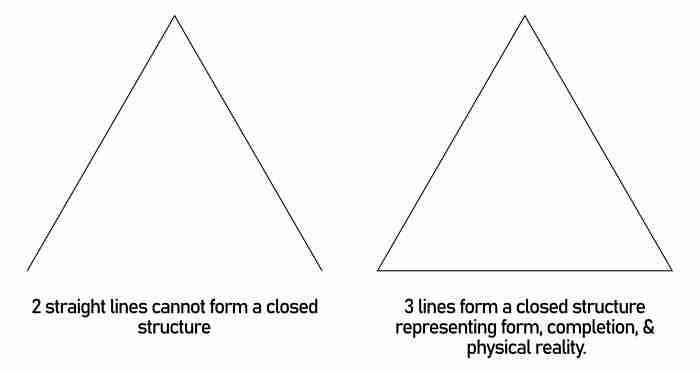
The equilateral triangle is the simplest polygon, with three sides of equal length. Like the Triquetra, it is represents trinity and other fundamental patterns that occur in sets of three, such as mind, body, and spirit.
Its perfectly balanced structure also makes it a symbol of harmony, balance, and stability.
More broadly, the triangle is the first closed geometric shape that can be formed using straight lines. Because of this, it is associated with completion, manifestation, and the physical world.
12. Hexagon & the Hexagram (Six-Pointed Star)
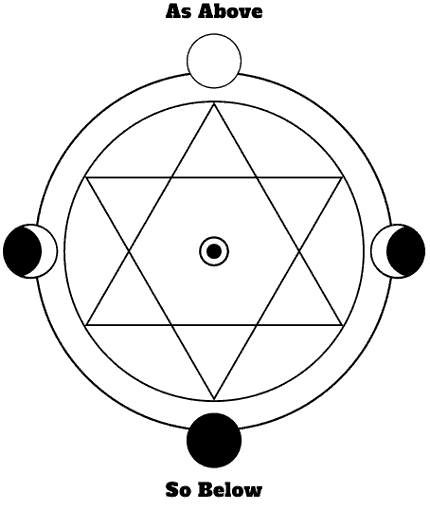
The Hexagram, or Six-Pointed Star, is formed by two interlocking equilateral triangles, one pointing upward and the other downward.
In sacred geometry, the upward-pointing triangle is associated with the Divine Masculine, while the downward-pointing triangle represents the Divine Feminine. Their union symbolizes balance, harmony, interconnectedness, and the creative forces that give rise to existence.
The central point where the triangles overlap represents the source from which all creation emerges.
The Six pointed star can be drawn by connecting every other vertex in a hexagram to form both triangles as shown in the image below.
The 3d version of this star is known as the Merkahab.
13. Unicursal Hexagram (Unicursal Six-Pointed Star)

The unicursal hexagram is a six-pointed star that can be drawn in one continuous movement without lifting the pen off the paper (as shown in the image below). This is unlike the regular hexagram (we saw above) that consists of two overlaid triangles and hence cannot be drawn in a single stroke.
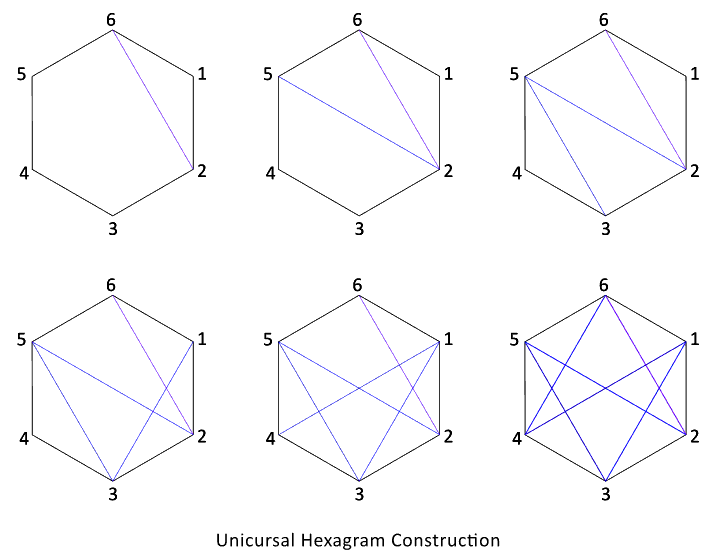
The unicursal hexagram symbolizes infinity, eternal life, magic, oneness, interconnection, and spiritual ascension.
14. Merkabah (Star Tetrahedron)
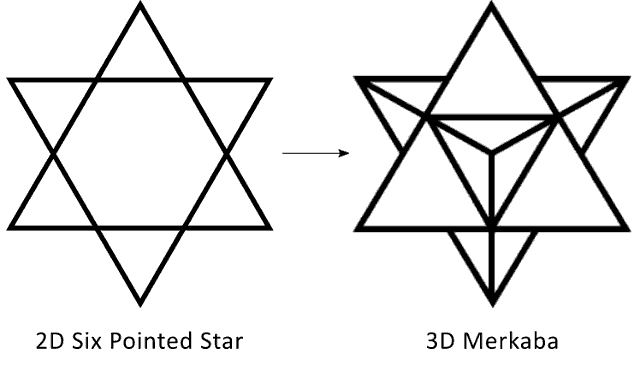
and Merkabah (Star Tetrahedorn)
Merkabah is the 3D representation of the 6 pointed star. It is a star shape formed by the fusion of two tetrahedrons (triangular pyramids). Hence it is also known as the Star Tetrahedron.
The upper tetrahedron represents the element of fire, masculine energy and the spirit world, whereas the lower tetrahedron represents water, feminine energy and the material world. Their fusion represents the essence of all creation.
Merkabah” is a Hebrew term that translates to “Chariot.” The word can be phonetically divided into three parts: “Mer,” meaning Light, “Ka,” signifying Spirit, and “Bah,” denoting Body. Thus the Merkahab symbolizes the union of Spirit (spiritual realm) and Body (material realm) that creates Life or Light.
Some even consider the symbol to have the power to transport your spirit and mind to higher realms when you meditate on it.
15. Octagon & the Octagram (Eight-Pointed Star)
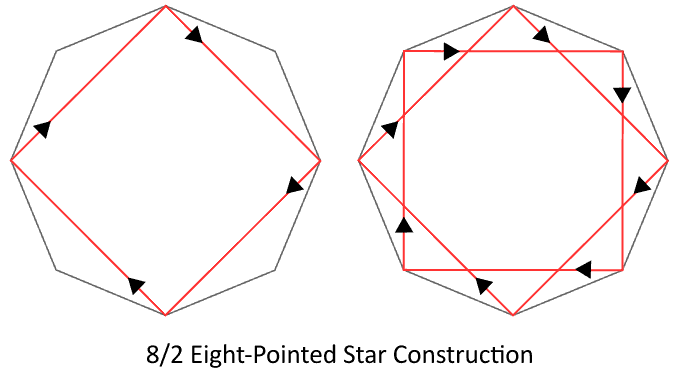
There are two types of 8-pointed stars that can be drawn using the octagon. The first, known as the 8/2 star, consists of two overlapping squares and is created by connecting every second vertex in the octagon as shown in the image below.
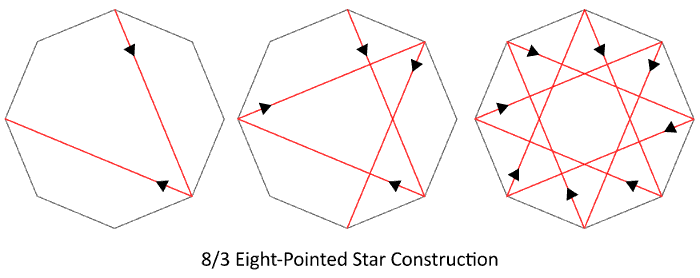
The second, often called the unicursal 8-pointed star (as it can be drawn in a single stroke) or the 8/3 star, is formed by connecting every third vertex in the octagon as shown in the image below..
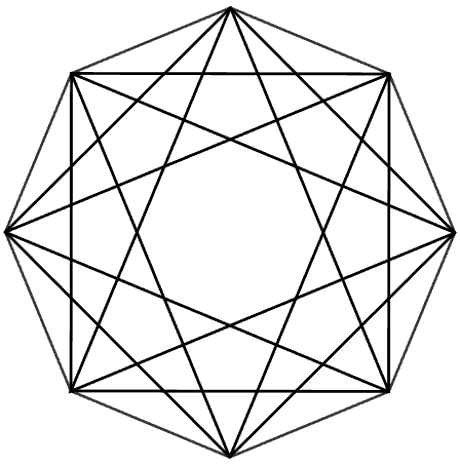
When combined, these stars form what is known as the Octagon Matrix.
Since ancient times, the 8-pointed star was used as a solar symbol representing the eight major solar events throughout the year: the four seasons, Spring, Summer, Autumn, and Winter, as well as the two equinoxes and two solstices.
The symbol is also associated with the planet Venus, which returns to nearly the same position in the sky every eight years. Because of this repeating pattern, the eight-pointed star symbolizes harmony, balance, renewal, and the cyclical nature of life and the cosmos.
Additionally, the 8-pointed star represents concepts of balance and creation.
16. Nonagon & the Nonagram (Nine-Pointed Star)
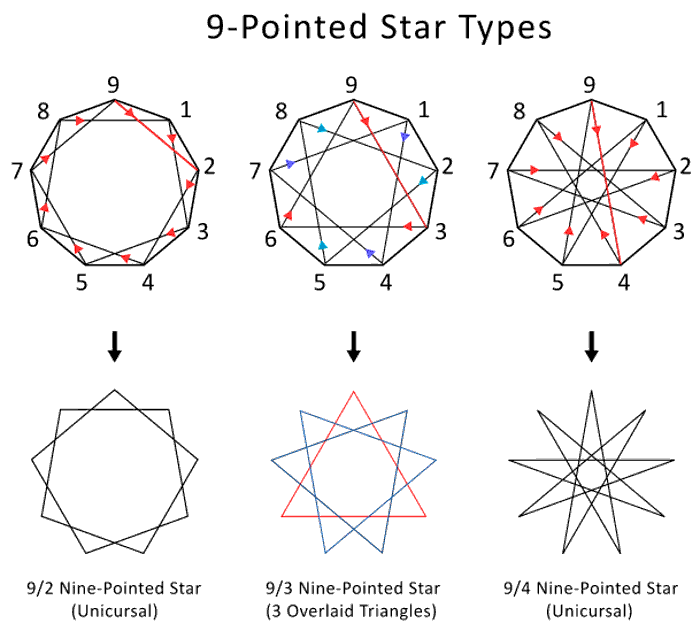
The Nine Pointed Star or the nonagram is a powerful sacred geometry symbol that can be drawn in 3 different ways as follows:
- 9/2 Nonagram: Formed by connecting every second vertex of a nonagon (9-sided polygon). This creates a unicursal star that can be drawn in one continuous line.
- 9/3 Nonagram: Formed by connecting every third vertex, creating a design made up of three overlapping equilateral triangles.
- 9/4 Nonagram: Formed by connecting every fourth vertex of a nonagon. Like the 9/2 nonagram, it is also unicursal and can be drawn in a single continuous line.
Each variation of the 9-pointed star has its own unique significance. However, generally speaking, the 9-pointed star symbolizes completeness, spiritual enlightenment, unity, oneness, interconnection, creation, omnipresence, source energy, and divine symmetry.
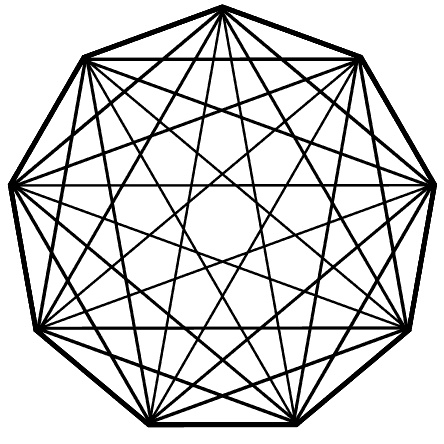
The image below illustrates all three stars combined known as the Nonagon Matrix.
Just like this, various star symbols can be drawn in sacred geometry like the 4-pointed, 5-pointed, 6-pointed, 7-pointed, 8-pointed star and so on. Here’s our article discussing all of these different types of star symbols and their symbolism.
17. Square
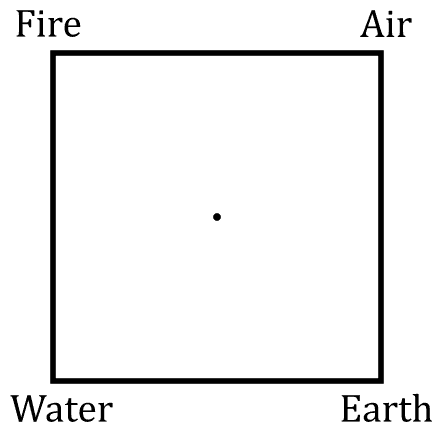
In sacred geometry, just like the circle represents the divine feminine, spirit and the spiritual realm, the square represents the divine masculine, matter, and the material realm.
The four corners of the square represent the four elements – Fire, Water, Earth, and Air that make up the material world. Similarly, the four corners also represent the four directions and the four seasons. The square also has a fixed, rigid structure unlike the circle and hence represents the divine masculine.
18. Squared Circle
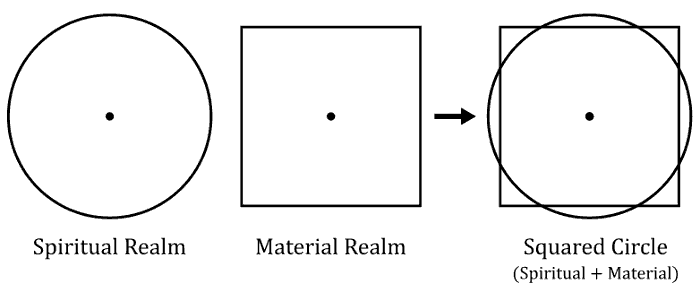
The Squared Circle is a sacred geometry symbol that depicts a circle inside a square. Both shapes share the same center and have the same surface area.
Like the six-pointed star, the Squared Circle is considered a powerful symbol of creation and the universe. The square represents the material world, while the circle represents the spiritual realm. Together, they symbolize the union of matter and spirit, from which all creation emerges.
Many sacred geometry symbols are derived from the Squared Circle. Some of the most well-known examples include the Philosopher’s Stone, the Five-Fold Knot, and the Witch’s Knot.
19. Philosopher’s Stone
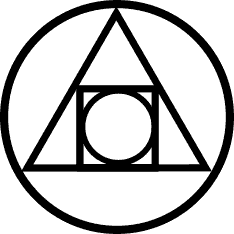
The Philosopher’s Stone is an ancient sacred geometrical symbol associated with transformation, manifestation, spiritual awakening, and the pursuit of higher consciousness. At its core is a squared circle, which is enclosed within a triangle and then surrounded by an outer circle.
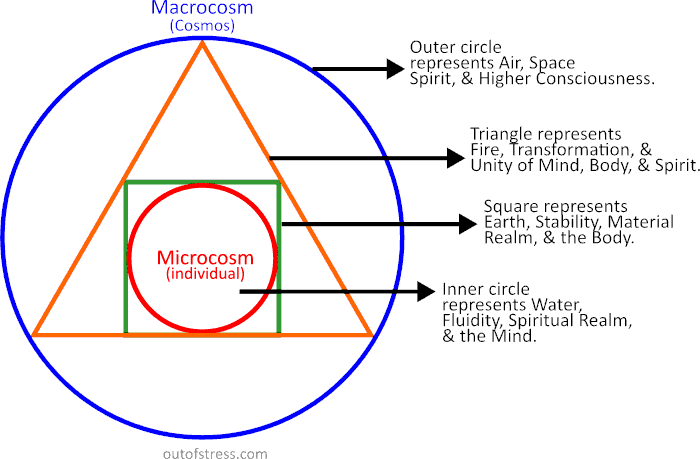
The circle at the core represents the mind, while the square represents the physical body.
The triangle symbolizes the union of mind, body, and spirit, a state of alignment that leads to higher consciousness, transformation, and inner harmony.
The outer circle represents universal intelligence or source energy, which becomes accessible when the mind, body, and spirit are brought into balance.
Viewed in this way, the Philosopher’s Stone serves as a symbolic blueprint for personal transformation, illustrating the journey from ordinary awareness to higher states of consciousness and self-realization.
20. Tetractys
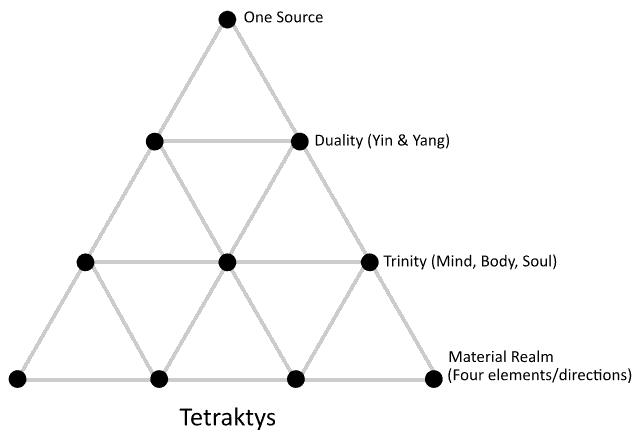
The Tetractys is a Pythagorean sacred geometry symbol that represents the structure of the universe and the process of creation. The symbol consists of ten dots arranged in a triangular pattern. The single dot at the top represents the One God, Source, or Universal Consciousness from which all things arise.
The two dots beneath it represent the One dividing into two complementary forces, the divine masculine and feminine. Together, they symbolize duality, the universal principle through which creation unfolds.
Finally the four dots at the base represent the four elements – Fire, Water, Earth, and Air that make up the material universe. Thus it suggests that the trinity is present within all four elements. The four dots also represent the four cardinal directions and the four seasons.
The Tetractys illustrates the journey from the One to duality, the trinity, and the manifested world. It suggests that understanding these principles can help one reconnect with the One Source or Universal Consciousness.
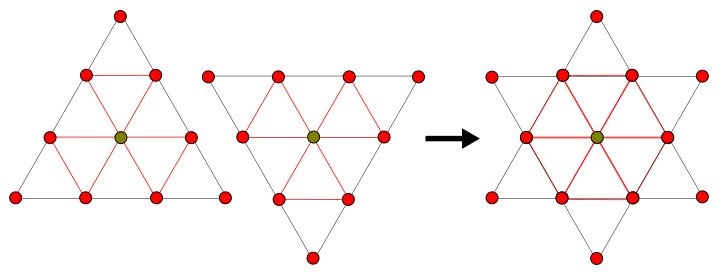
Interestingly, if you overlap two tetractys one pointing up and the other pointing down, you get the hexagram as shown in the image above.
21. Vector Equilibrium (Cuboctahedron)
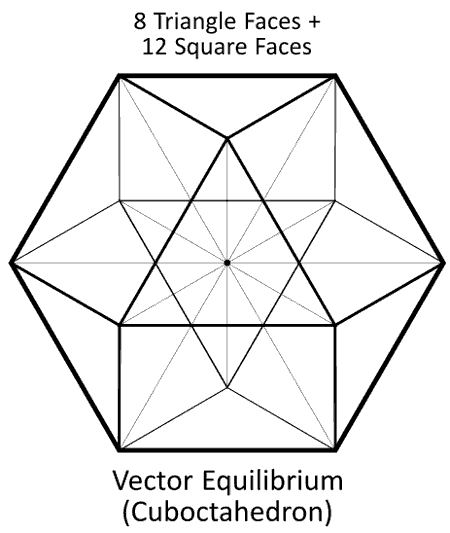
The Cuboctahedron, also known as the Vector Equilibrium, is a sacred geometric form made up of 8 triangular and 6 square faces. It features 12 identical vertices, where two triangles and two squares coverage. The shape also has 24 equal-length edges, each separating a triangle from a square.
The Vector Equilibrium is considered one of the most balanced 3D forms as each one of its points is equidistant from the center. This makes it the only form where all forces are balanced and equal.
Interestingly, by folding along its square edges, the Cuboctahedron can be transformed into other balanced and symmetrical shapes like the icosahedron, octahedron, and tetrahedron (which are platonic solids). This makes the Vector Equilibrium a potent symbol of balance, unity, and harmony.
22. Yin Yang
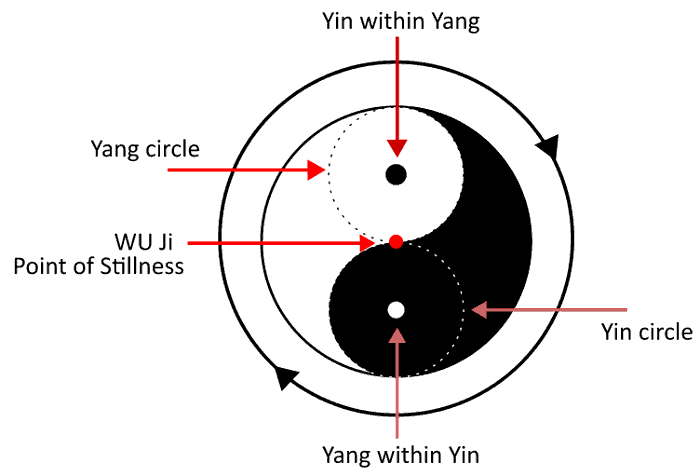
The Yin Yang is one of the most recognized and profound symbols in sacred geometry. It primarily represents the concept of creation that happens by the interaction between the divine masculine (represented by the black section) and the divine feminine (represented by white).
A unique feature of the symbol is the small white dot within the black half and the black dot within the white half. This illustrates that every force contains the seed of its opposite: Yin exists within Yang, and Yang exists within Yin. Though they appear to be opposites, they are inseparable and interdependent.
The flowing shape of the symbol also represents the cyclical nature of existence, showing how Yin transforms into Yang and Yang into Yin in an endless dance of balance, change, and renewal.
23. Yantras

Yantras (visual mantras), are powerful geometric designs in Hinduism that have been used since ages for meditation, attracting positive energies, manifestation, protection, and attaining higher spiritual states. Generally, there are 56 recognized Yantras, each with its unique miraculous advantages.
The most powerful of all yantras is the Sri-Yantra depicted in the image above. It represents creation, manifestation, health, and higher consciousness. Given below are images of some more popular yantras.
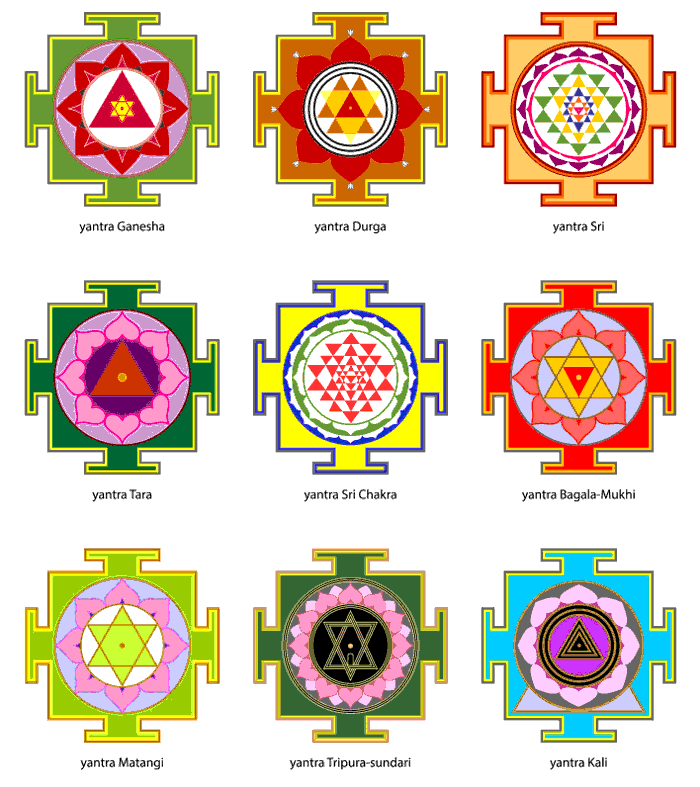
Here’s a list of some important Yantras and their symbolic meanings:
- Sri Yantra: For learning, wisdom, creativity, finance, beauty, and spiritual enrichment.
- Kanakdhara Yantra: For attracting gold and wealth.
- Durga Yantra: For power, strength, and protection against enemies.
- Kuber Yantra: For financial prosperity and wealth accumulation.
- Mahamrityunjaya Yantra: For health and protection against untimely death.
- Ganesha Yantra: For removing obstacles and bringing success in endeavors.
- Lakshmi Yantra: For prosperity, success, and good fortune.
- Navagraha Yantra: For pacifying the nine planets and gaining their positive influences.
The concept of yantras is very deep and we will be discussing that in another article.
Conclusion
In summary, sacred geometry symbols are more than just intricate designs; they are symbolic maps of the patterns and principles that shape the universe.
Each symbol explored in this article contains layers of meaning that reveal themselves through deeper study. One of the best ways to engage with sacred geometry is to recreate the symbols yourself, either by hand using a ruler and compass or digitally using geometry software such as GeoGebra.
Constructing these forms can provide a deeper appreciation of their beauty, symmetry, and underlying symbolism.