Since ancient times, people have used symbols to express profound spiritual ideas about the nature of existence, consciousness, and awakening. Unlike words, symbols communicate directly with the subconscious mind, allowing them to convey deeper truths that can be difficult to explain through language alone.
This is one reason spiritual symbols have appeared across cultures and civilizations throughout history. They served not only as sacred images, but also as tools for contemplation, meditation, and inner transformation.
In this article, we’ll explore 22 powerful ancient spiritual symbols and the deeper meanings they have carried through the ages.
1. Yin Yang
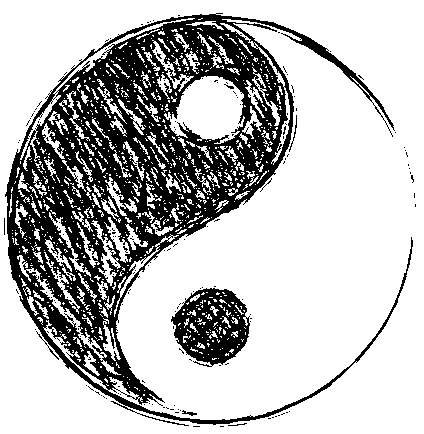
The Yin Yang is one of the most recognized spiritual symbols from ancient China. It represents existence as the interaction of two interconnected forces: the divine masculine, symbolized by the black half, and the divine feminine, symbolized by the white half. As these forces alternate between activity and receptivity, they create the cycles and changes seen throughout life.
In fact, the symbol also points to a deeper spiritual concept known as Wu Ji. Wu Ji represents a state of stillness and neutrality that exists beyond the play of opposing forces.

Ancient spiritual teachings describe this state as one that can be experienced through deep meditation and heightened awareness. In this sense, Wu Ji symbolizes spiritual awakening, a return to the stillness that exists beyond duality.
2. Lotus
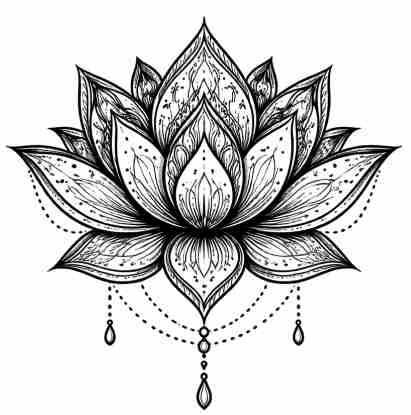
Various ancient traditions regard the lotus flower as a powerful spiritual symbol. This is because it rises from muddy waters yet blooms pure and untouched. Its journey mirrors the path of inner growth, where wisdom and awareness emerge through life’s challenges.
In Hinduism and Buddhism, the lotus symbolizes the unfolding of consciousness, with its petals representing the expansion of awareness into higher states of being.
In fact, the crown chakra, regarded as the highest energy center in the body, is known as Sahasrara in Sanskrit, which translates to “thousand-petaled lotus.” It is traditionally depicted as a lotus with many petals.
This chakra is associated with pure consciousness, spiritual enlightenment, and union with the divine. Through this connection, the lotus came to symbolize the journey from ordinary awareness to spiritual realization.
3. Vesica Piscis
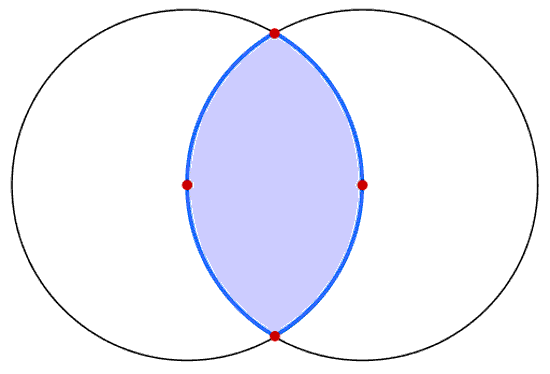
The Vesica Piscis is one of the oldest and most important symbols in sacred geometry. It is formed by two overlapping circles, with each circle passing through the center of the other.
Across ancient spiritual traditions, this geometric form has been used to represent the meeting of complementary forces that give rise to creation itself.
The two circles symbolize duality: the divine masculine and feminine, spirit and matter, the conscious and subconscious, and the analytical and intuitive aspects of the mind. Rather than opposing one another, these forces exist in relationship and balance.
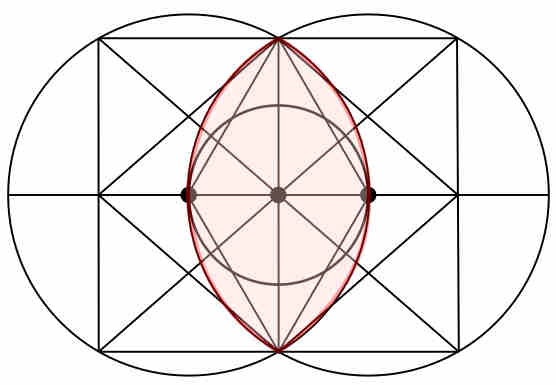
Their intersection creates a lens-like shape at the center. This form, resembling an eye or portal, is associated with the third eye, pointing to awareness beyond the material world. In sacred geometry, it also represents the cosmic womb from which creation emerges. It symbolizes the birth of existence through the union of complementary forces.
By adding more circles to the Vesica Piscis, other sacred geometry symbols begin to emerge, including the Triquetra, the Seed of Life, and the Flower of Life.
4. Triquetra
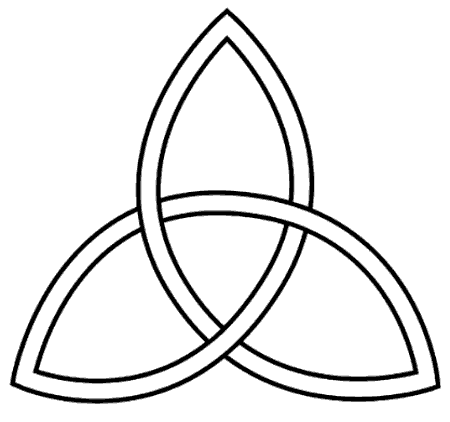
The Triquetra is an ancient spiritual symbol found across many traditions. It emerges when we add an additional circle to the Vesica Piscis (as shown in the image below).

The symbol represents important trinities found in nature, including Mind, Body, and Spirit; Creation, Preservation, and Destruction; Past, Present, and Future; Birth, Life, and Death; and Heaven, Earth, and the Underworld.
At its core, the Triquetra symbolizes the unity and balance of these three interconnected forces.
5. Hexagram

The hexagram is formed by two overlapping triangles, one pointing upward and the other downward.
The upward triangle represents the divine masculine, while the downward triangle represents the divine feminine. Where they meet at the center represents balance, unity, creation, and higher awareness.
In many traditions, triangles also symbolize the four elements. Fire and Air are represented by upward-pointing triangles and are considered masculine elements. Earth and Water are represented by downward-pointing triangles and are considered feminine elements.
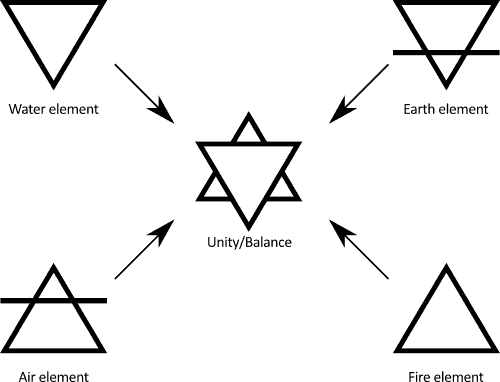
When these opposing forces and elements come together, they form the hexagram (as shown in the image above) representing divine harmony and balance. Thus the six-pointed star, is a powerful symbol of wholeness and spiritual awakening.
6. Merkaba
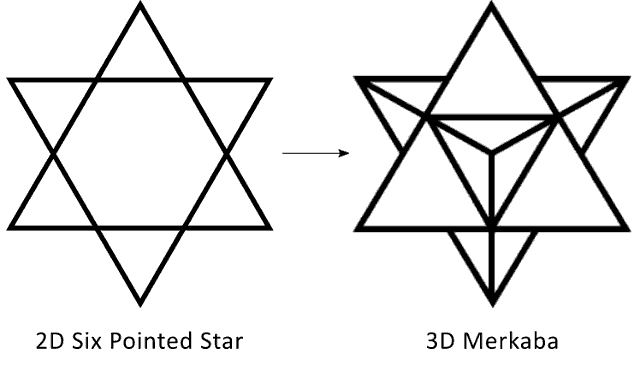
and Merkabah (Star Tetrahedorn)
The Merkaba is the three-dimensional form of the hexagram and is regarded as a powerful symbol of spiritual awakening and ascension. It consists of two interlocking tetrahedrons, one pointing upward and the other downward.
The upward tetrahedron (that is seen as spinning clockwise) represents the divine masculine, while the downward tetrahedron (that spins counter-clockwise) represents the divine feminine. Together, they symbolize the balance and union of complementary forces, giving rise to creation and higher consciousness.
In fact, the word Merkaba is also interpreted as three parts: Mer (light), Ka (spirit), and Ba (body). It represents the alignment of body, spirit, and consciousness, pointing to a state of higher awareness.
7. Infinity symbol
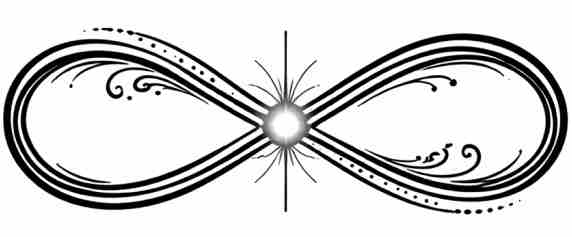
The infinity symbol is an ancient symbol of eternity, balance, and the continuous cycle of creation.
Its two loops represent the dual aspects of existence, representing the divine masculine and divine feminine.
This central point where the loops intersect symbolizes pure consciousness beyond duality, a state associated with deep meditation and spiritual awakening. In this sense, the infinity symbol represents unity and the connection between all things.
According to ancient Egyptian tradition, the infinity symbol is linked to Thoth, the god of wisdom, knowledge, and sacred sciences. Variations of the symbol were also used in ancient Egyptian symbolism and appeared on royal and sacred imagery.
8. Tetractys
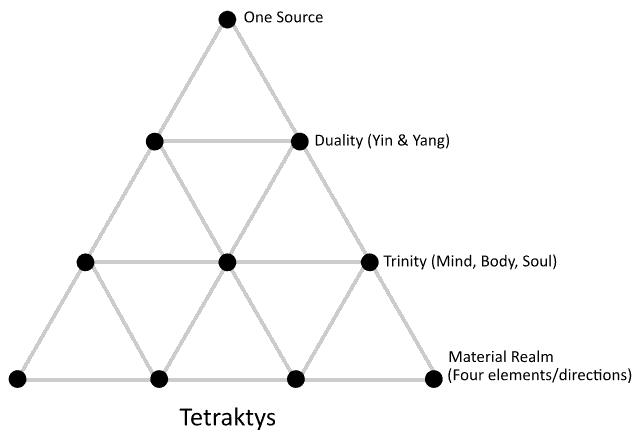
The Tetractys is a sacred Pythagorean symbol (but the origin of this symbol could be much older) formed by ten dots arranged in a triangular pattern across four rows.
The single dot at the top signifies the one consciousness. Below it, the two dots represent duality, the fundamental opposites present in existence. The next row of three dots symbolizes the trinity of mind, body, and soul. At the bottom, the four dots represent the physical world, built from the four elements: fire, air, water, and earth.
In this way, the Tetractys represents a journey from the material world to higher consciousness.
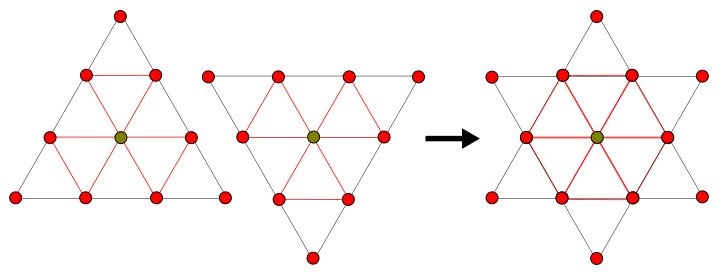
Interestingly, when two Tetractys are overlapped, one facing upward and the other downward, they form the hexagram.
9. Octahedron
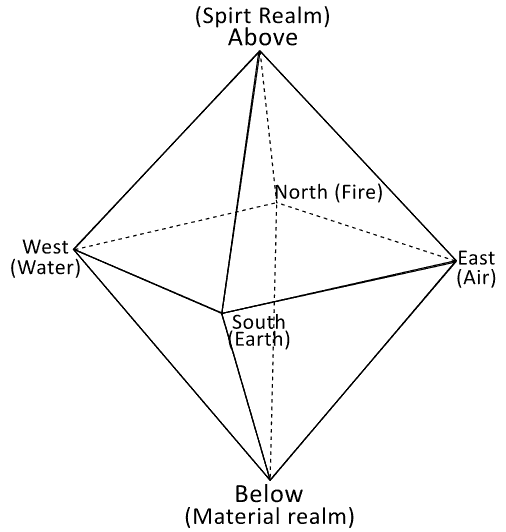
The Octahedron is one of the five Platonic solids and is formed by two square pyramids joined at their bases.
The upward-facing pyramid represents the masculine elements of Fire and Air, while the downward-facing pyramid represents the feminine elements of Earth and Water.
For this reason, the Octahedron symbolizes balance, duality, life force, and creation through the union of complementary energies. This deeper symbolism is also the reason why it is considered an important spiritual symbol.
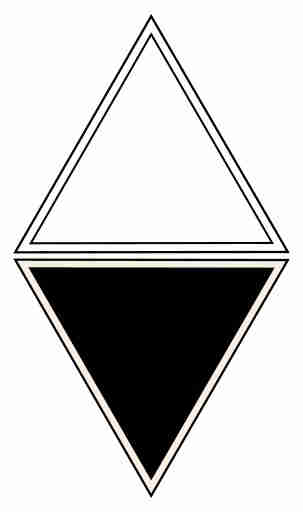
In its two-dimensional form, the Octahedron resembles two overlapping triangles, one facing upward and the other downward, a pattern that has long been used to represent the dual nature of existence.
10. Pine Cones
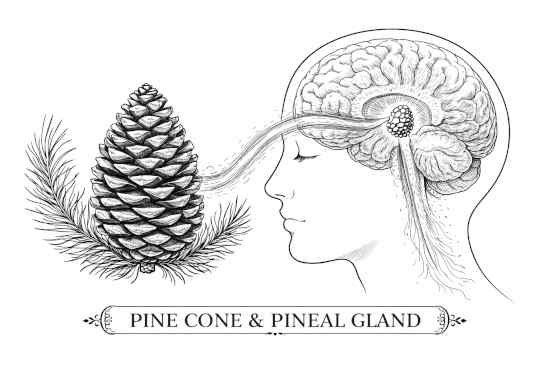
Many ancient traditions connected the pine cone with the pineal gland and saw it as a symbol of higher awareness and spiritual awakening.
In fact, the word “pineal” comes from the Latin word pinea, meaning “pine cone.” The gland gets its name from its pine cone-like shape.
In traditions such as Hinduism, the pineal gland is linked to the “third eye,” which is associated with inner vision and awareness. It is believed that meditation focused on the center of the forehead helps activate this center, leading to deeper insight and heightened perception.
11. Auseklis
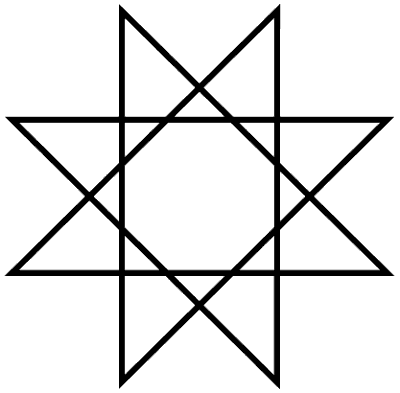
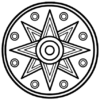
The eight-pointed star is an ancient symbol revered across many cultures. It has long been associated with Venus, which was known as both the Morning Star and the Evening Star because it appears brightly in the sky just before sunrise and shortly after sunset.
Due to its connection with Venus, the symbol came to represent beauty, harmony, love, fertility, renewal, divine guidance, and the balance between earthly and spiritual realms.
Variations of the eight-pointed star appear in many traditions, including the Star of Ishtar and the Star of Inanna in Mesopotamia, the Star of Lakshmi in Hinduism, the Auseklis (Morning Star) symbol in Latvian tradition, and other sacred star motifs found throughout Europe, the Middle East, and Asia.
12. Witch’s Knot
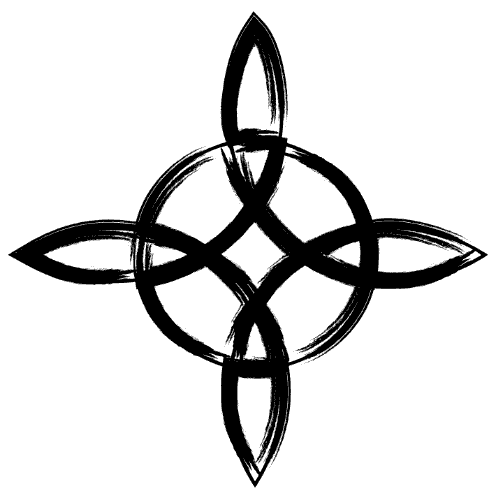
The Witch’s Knot is an ancient Celtic symbol that has long been associated with magic, protection, and manifestation. Its four interwoven arms represent the four elements: Earth, Water, Air, and Fire, while the central circle represents the fifth element, Ether, Spirit, or Source energy.
The four arms are also linked to the four cardinal directions: North, South, East, and West. In addition, they can represent the four seasons, the four phases of the moon, and the four stages of life.
By bringing these forces together into a single design, the Witch’s Knot symbolizes balance, interconnectedness, and the flow of energy between the physical and spiritual realms.
13. Dharma Chakra
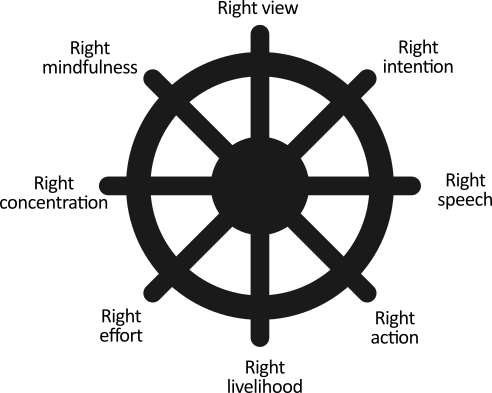
The Dharma Chakra is an ancient Buddhist symbol that represents the path to spiritual awakening. Its eight spokes symbolize the Noble Eightfold Path, the core teachings of Buddhism for overcoming suffering and attaining enlightenment.
The eight spokes represent Right View, Right Intention, Right Speech, Right Action, Right Livelihood, Right Effort, Right Mindfulness, and Right Concentration.
Together, they illustrate a complete path of ethical living, mental discipline, and wisdom that leads to higher awareness and spiritual liberation.
14. Lakshmi Star
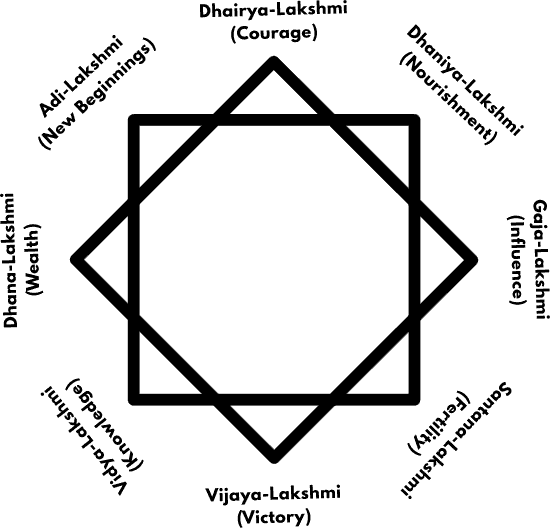
The Lakshmi Star is an ancient Vedic symbol made of two overlapping squares, with one square rotated over the other. It is associated with Goddess Lakshmi, the Hindu goddess of wealth, prosperity, and abundance.
The symbol represents the eight powers, or forms of energy, associated with Lakshmi. These include material wealth, power, success, courage, knowledge, fertility, prosperity, and spiritual abundance.
Together, these eight energies symbolize both material and spiritual well-being, making the symbol a representation of complete prosperity and fulfillment.
15. Sri Yantra

Yantras are sacred geometric diagrams used in Hindu spiritual practices as tools for meditation, concentration, and spiritual growth.
The most well-known of these is the Sri Yantra, which consists of multiple interlocking triangles that converge at a central point known as the Bindu. This point represents the source of creation and pure consciousness.
In traditional practice, meditators focus on the Bindu to quiet the mind and deepen awareness. It is believed that this practice can promote inner balance, healing, clarity, and spiritual awakening.
Some other popular yantras include the Ganesha Yantra, linked to removing obstacles; the Lakshmi Yantra, connected with prosperity; the Saraswati Yantra, associated with knowledge; and the Durga Yantra, which symbolizes protection and courage.
16. Seed of Life

The Seed of Life is formed by adding six overlapping circles around a central circle. It is regarded as a symbol of creation and is believed to contain the fundamental blueprint of the universe.
In fact, if you connect the centers of certain circles within the pattern, geometric shapes such as the equilateral triangle and hexagram begin to emerge. For this reason, the Seed of Life can be seen as a circular expression of the hexagram (that we saw earlier).
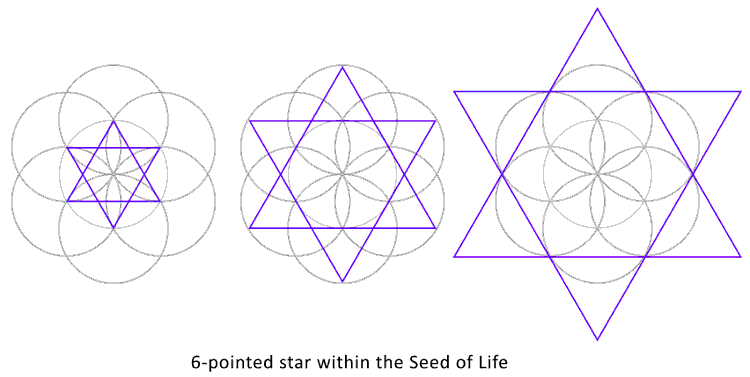
Like the hexagram, it symbolizes creation, divine balance, harmony, unity, interconnectedness, and the union of complementary forces.
The Seed of Life has been found in several ancient cultures. One of the most famous examples appears at the ancient Temple of Osiris in Egypt. Similar geometric patterns have also appeared in sacred art throughout the ancient Middle East, Europe, and Asia.
17. Lotus of Life

When two Seed of Life patterns are superimposed and one is rotated by 30 degrees, they form the Lotus of Life pattern. This sacred geometric design symbolizes purity, balance, harmony, unity, strength, and spiritual enlightenment.
18. Torus

The Torus is another sacred geometric form that can be derived from the Seed of Life. When multiple Seed of Life patterns are stacked and gradually rotated, they create a torus-shaped structure.
The torus is widely recognized as a pattern found in magnetic and energy fields. It is used to represent the flow of energy through a self-sustaining system, moving outward from the center and returning back to it.
Because of this continuous flow, the Torus has become a symbol of wholeness, balance, interconnectedness, and the cyclical nature of creation.
Although the term “torus” is modern, torus-like patterns have appeared in many ancient spiritual traditions including in Hindu, Buddhist, Egyptian, and Celtic art.
19. Solar Cross

The Solar Cross is an ancient pagan symbol consisting of a cross enclosed within a circle. The vertical and horizontal arms represent the union of masculine and feminine energies, while their intersection symbolizes the point of creation and balance.
The surrounding circle represents wholeness, eternity, and the cyclical nature of life, including the cycles of the seasons, the Sun, and the cosmos.
The symbol has been found across many ancient cultures, including prehistoric rock carvings in Scandinavia, Bronze Age artifacts throughout Europe, Celtic monuments, and ancient solar imagery from regions of the Middle East and India.
Its widespread appearance suggests that it was one of humanity’s earliest symbols of cosmic order and the cycle of life.
20. Tree of Life
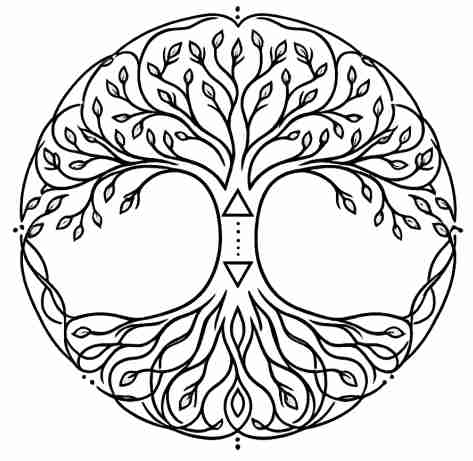
One of the most widespread spiritual symbols found across ancient cultures is the Tree of Life. While it appears in many forms, its core meaning remains remarkably similar.
The trunk represents the physical world, the roots symbolize the inner self, and the branches reaching toward the sky represent higher consciousness and spiritual growth.
The symbol teaches that true growth begins within. Just as a tree can only grow tall when its roots grow deep, higher states of awareness are reached by first connecting with one’s inner self.
The Tree of Life also represents the three planes of existence which are the underworld, earthly realm, and heavens, as well as the cyclical nature of life, interconnectedness, wisdom, renewal, and the continuous journey of spiritual evolution.
21. Mandalas
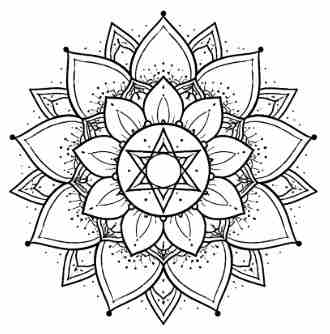
Mandalas are intricate circular patterns found in Hindu and Buddhist traditions. They are made up of repeating geometric shapes such as circles, triangles, squares, and lines arranged around a central point.
These patterns represent wholeness, balance, the structure of the cosmos, and the journey from the outer world to the inner self.
In many spiritual traditions, gazing at or creating a mandala is used as a form of meditation. The practice helps calm the mind, improve focus, and cultivate deeper states of awareness and inner peace.
22. Trident
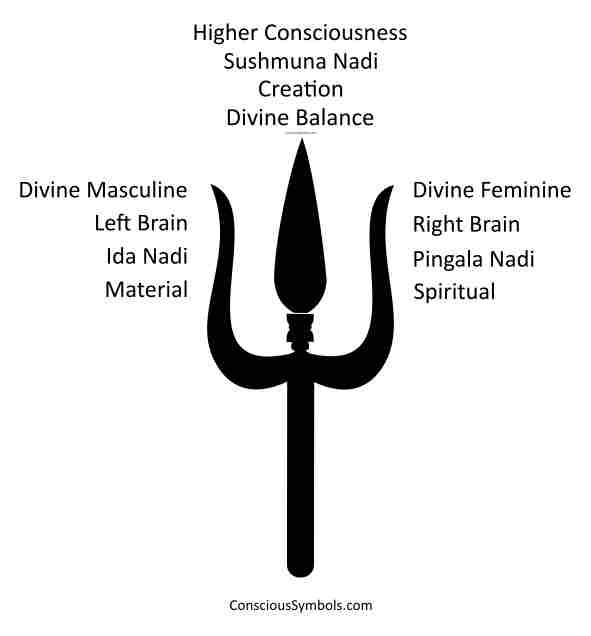
The trident is a powerful spiritual symbol found across many ancient traditions. Numerous deities in Hindu, Greek, and Roman mythology are depicted carrying a trident, highlighting its sacred significance.
The two outer prongs of the trident are represent duality, including the left and right aspects of the mind. The central prong represents higher awareness, which emerges when these opposing forces are brought into balance.
The central shaft symbolizes the spine and the upward movement of life force or spiritual energy. For this reason, the trident is widely seen as a symbol of balance, meditation, spiritual power, and higher consciousness.
Conclusion
Spiritual symbols are more than artistic designs. They contain deep insights about the universe, consciousness, and the nature of existence. Through simple shapes and patterns, they communicate ideas that are difficult to fully express in words or grasp through logic alone.
This is why ancient cultures placed such importance on symbols. They used them as tools for contemplation, meditation, and spiritual growth. By reflecting on these symbols and their meanings, we can gain a deeper understanding of ourselves and the hidden principles that shape reality, making them powerful companions on the journey of spiritual awakening.